
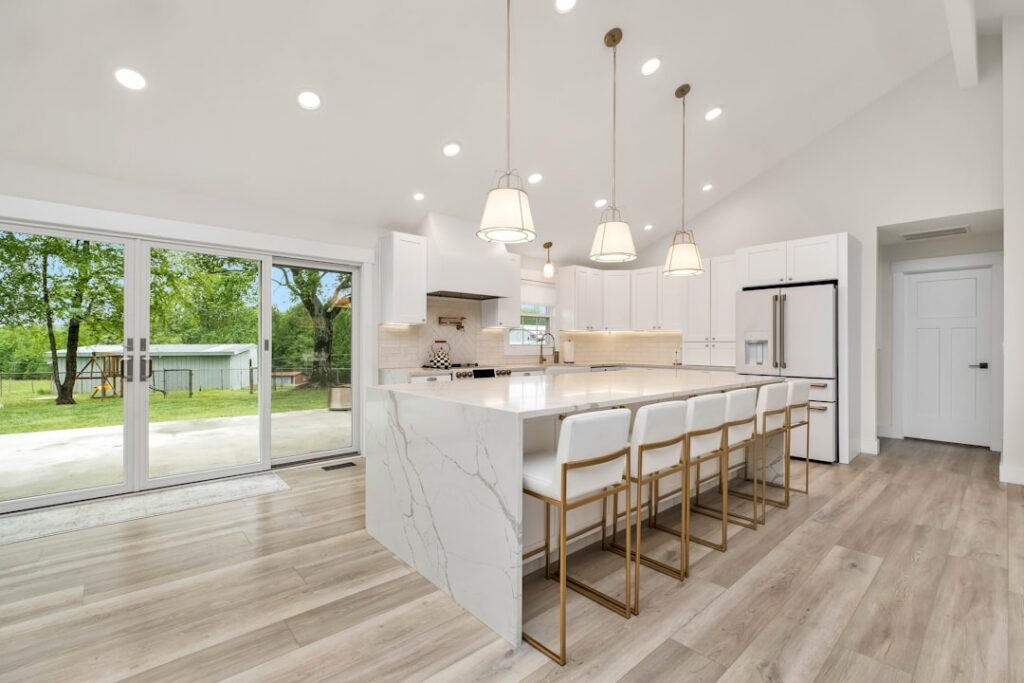
What You Need to Know About Kitchen Remodeling in 2026
Kitchen remodeling is one of the most impactful home upgrades you can make — both for daily living and long-term home value. Here’s a quick snapshot before we dive deep:
| Factor | Key Facts |
|---|---|
| Average cost (medium remodel) | $71,159 nationally |
| Typical ROI | 50–60% of project cost added to home value |
| Timeline | 6–12 weeks (often 3–6 months in reality) |
| Top 2026 style | Warm minimalism — taupes, white oak, slab cabinets |
| Permits required? | Yes, for electrical, plumbing, or structural changes |
| Biggest budget item | Cabinets (up to 30–40% of total budget) |
| Best budget-friendly upgrade | Hardware swaps, cabinet painting, layered lighting |
The kitchen has always been important. But it’s become something more in recent years — a social hub, a workspace, a design statement, and a wellness space all at once. Industry data backs this up: 76% of kitchen and bath professionals expect kitchen footprints to expand over the next three years, even as overall home sizes stay flat or shrink.
That shift changes everything about how you plan a remodel. The choices you make today — materials, layout, lighting, storage — will shape how your family lives in that space for the next 10 to 15 years.
Whether you’re dealing with a cramped galley that slows down every meal, outdated cabinets that chip away at your home’s value, or just a kitchen that no longer fits your life, this guide walks you through everything: costs, trends, timelines, permits, and the mistakes most homeowners don’t see coming.
I’m Norbert, and with 25 years of hands-on kitchen remodeling experience across the Chicagoland area, I’ve seen what separates a smooth, successful remodel from a stressful, over-budget one. Read on — and by the end, you’ll know exactly how to approach your own kitchen remodeling project with confidence.
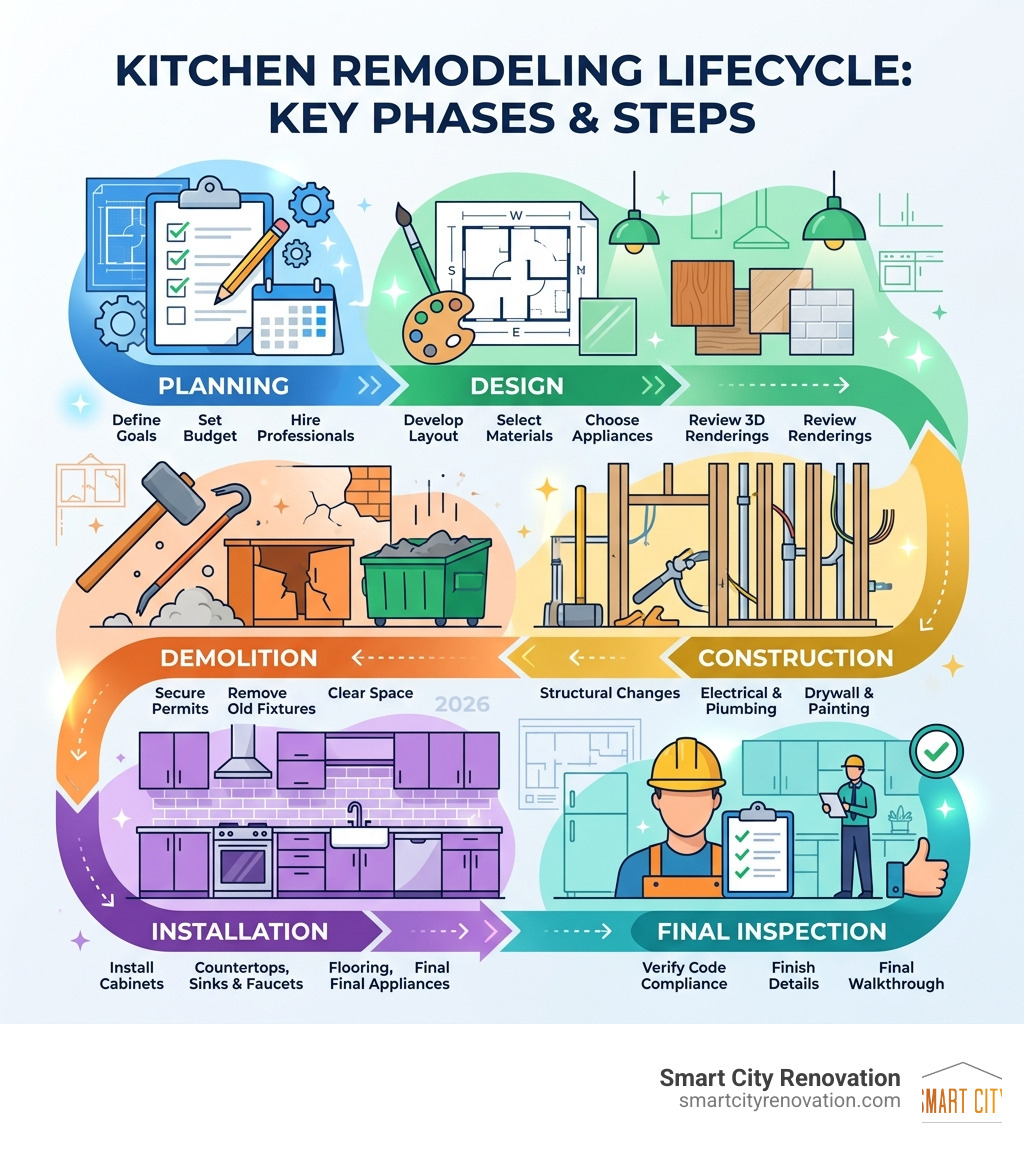
Planning Your 2026 Kitchen Remodeling Project
Planning is the most critical phase of any renovation. In 2026, we are seeing a massive shift toward “anthropocentric design”—a fancy way of saying we are designing spaces centered entirely on human comfort and movement rather than just looking “pretty” in a magazine.
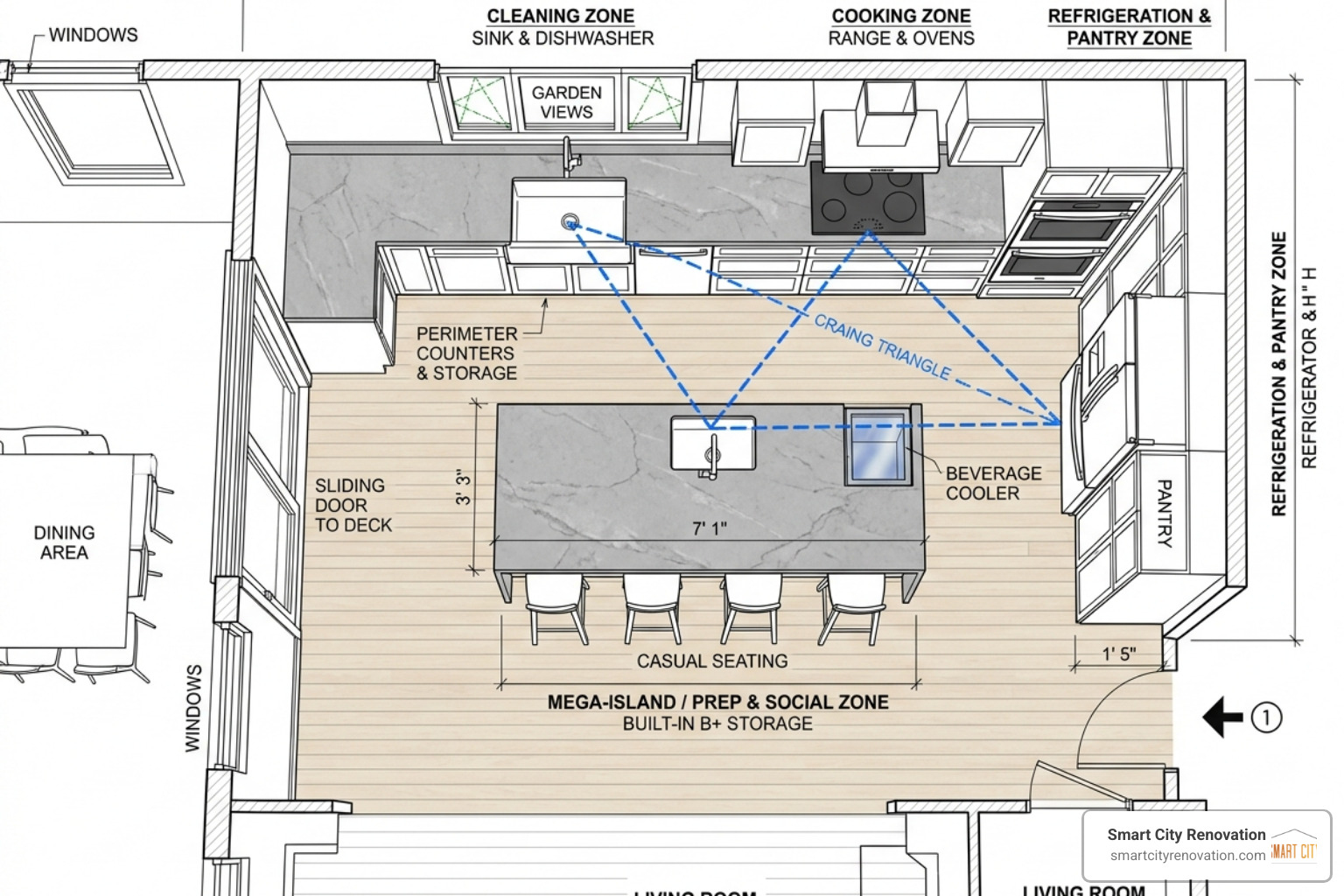
As we mentioned, 76% of pros see kitchen footprints expanding. In the Chicagoland area—from Des Plaines to Skokie—homeowners are increasingly knocking down walls to merge the kitchen with the living area. This creates room for the “mega-island.” We’re seeing 40% of homeowners now choosing kitchen islands that are 7 feet or longer. These aren’t just for prep; they are for homework, remote work, and hosting.
When planning your layout, the classic “work triangle” (the distance between your sink, stove, and fridge) still matters, but it’s evolving into “work zones.” This includes adding workstation sinks—large basins with integrated cutting boards and drying racks—that turn the sink area into a multi-functional prep hub.
If you are feeling overwhelmed by the structural possibilities, you can learn more about how a general contractor manages these complex layout changes to ensure your home remains safe and sound.
The Evolving Role of the Modern Kitchen
The kitchen is no longer just a room; it’s the home’s engine room. We are seeing a rise in the “disappearing kitchen” trend. This involves hiding appliances behind custom panels and using “sculleries” or butler’s pantries. The idea is to have a “show kitchen” that stays pristine for guests, while the heavy-duty cooking, coffee making, and dishwashing happen in a secondary, hidden space.
Budget-Friendly Kitchen Remodeling Updates
Not every kitchen remodeling project requires tearing out the floorboards. If your layout works but the look is dated, high-impact refreshes can save you tens of thousands of dollars.
- Hardware Swaps: Replacing old handles with unlacquered brass or oil-rubbed bronze can cost as little as $50–$500 but changes the entire “feel” of the room.
- Cabinet Painting: Moving away from stark white to “mushroom” or “putty” tones can refresh the space for a fraction of the cost of new boxes.
- Layered Lighting: Adding under-cabinet LEDs and toe-kick lighting (the lights at the very bottom of your cabinets) adds depth and safety without a full rewire.
- Storage Hacks: Retrofitting toe-kick drawers into existing cabinets allows you to reclaim wasted space for baking sheets or step stools.
Kitchen Remodeling Costs and ROI in 2026
Let’s talk numbers. Budgeting for a kitchen remodeling project in 2026 requires a realistic look at material inflation and labor shortages. Nationally, a medium-sized remodel averages around $71,159. However, costs can vary wildly based on your specific goals.
| Remodel Scope | Estimated Cost Range (2026) | Typical Features |
|---|---|---|
| Minor / Refresh | $18,000 – $27,500 | Painting cabinets, new hardware, mid-range appliances, new backsplash. |
| Medium / Mid-range | $70,000 – $85,000 | New semi-custom cabinets, quartz counters, flooring, high-end sink, some lighting. |
| Major / Upscale | $130,000 – $160,000+ | Structural changes, custom cabinetry, professional-grade appliances, natural stone. |
For a more granular look at how these numbers are calculated, you can check out current cost data to see how your wishlist aligns with market rates.
The good news? A kitchen remodel remains one of the best investments you can make. You can typically expect an ROI of 50-60%. For example, a $75,000 remodel could add roughly $37,000 to $45,000 to your home’s resale value. More importantly, it increases “joy value”—the daily satisfaction of living in a space that actually works. We always recommend setting aside a 20% contingency fund. Whether it’s finding moldy insulation behind a wall or an old pipe that isn’t up to code, surprises happen.
National vs. Regional Cost Breakdowns
In the Midwest, and specifically our service area stretching from Arlington Heights to Northbrook, costs stay relatively close to national averages, though permit fees and specialized labor for historic homes can add a premium. While some coastal areas see “upscale” projects hitting $155,000 easily, many Chicagoland homeowners find the “sweet spot” in the $60,000 to $90,000 range by choosing mid-range materials that offer high durability.
Prioritizing Features for Maximum Value
If you have to choose where to spend your money, prioritize these three areas:
- Energy-Efficient Appliances: Modern refrigerators are up to 70% more efficient than models from 15 years ago.
- Quartz Countertops: While marble is beautiful, quartz offers heat resistance and zero maintenance, making it a favorite for 2026.
- Powerful Ventilation: 85% of pros now rank high-quality vent hoods as a top priority for air quality and protecting your new cabinetry from grease and steam.
Top Design Trends and Materials for 2026
The “all-white” kitchen is officially taking a backseat. In 2026, the trend is “warm minimalism.” We are seeing a move toward stony greiges, mushrooms, and taupes. In fact, 96% of professionals now recommend neutrals that lean “warm” rather than “cool.”
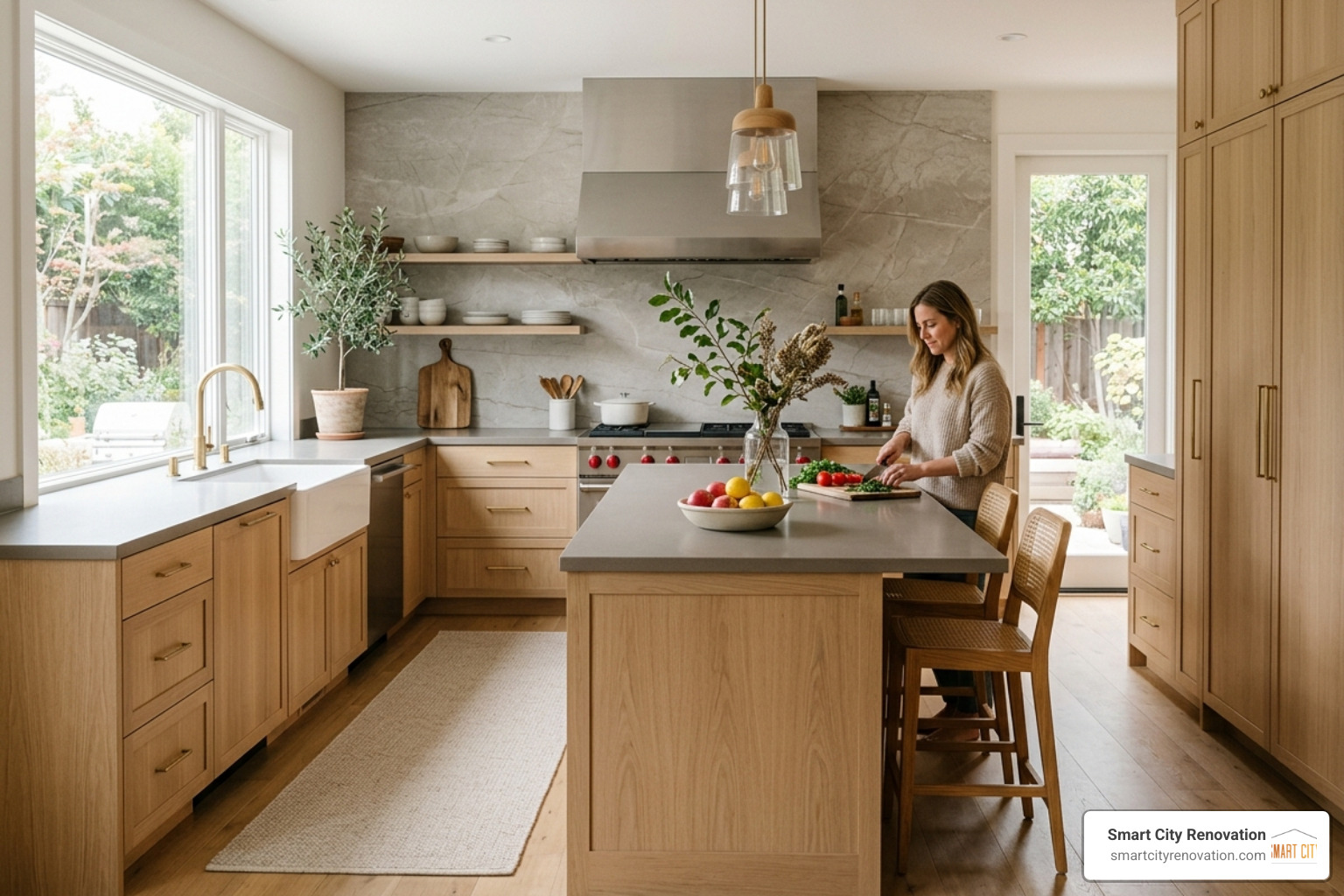
Natural materials are the stars of the show. Stained wood cabinets are surpassing painted finishes for the first time in years, with white oak leading the pack at 51% popularity. This “biophilic” approach—bringing the outside in—helps create a serene, calming environment.
When it comes to floors, homeowners are moving away from cold tile. If you’re considering a change, our guide to natural stone flooring explains how to choose materials that handle the heavy foot traffic of a busy kitchen.
Warm Minimalism and Color Palettes
The 2026 palette is all about “putty” and “earth tones.” We are also seeing “color drenching”—where the cabinets, walls, and even the ceiling are painted in the same muted shade to create a seamless, immersive look. Matte finishes are preferred over high-gloss, as they hide fingerprints better and feel more sophisticated.
Cabinetry and Countertop Innovations
- Slab Doors: 69% of designers report that flat-panel (slab) cabinet doors are gaining popularity. They are easier to clean and fit the minimalist aesthetic perfectly.
- The “Countersplash”: This is a major 2026 trend. Instead of a tile backsplash, homeowners are extending their countertop material (usually a large-format quartz or stone slab) all the way up the wall to the bottom of the cabinets. It’s a sleek, monolithic look that eliminates grout lines.
- Panel-Ready Everything: 72% of refrigerators and 85% of dishwashers in new remodels are being “hidden” behind cabinet panels to maintain the clean lines of the kitchen.
The Step-by-Step Kitchen Remodeling Process
Understanding the sequence of events can save you a lot of gray hairs. A typical kitchen remodeling project follows a very specific order to ensure no work has to be redone.
For a detailed breakdown of the timeline, you can refer to this step-by-step guide, but here is the general flow we follow at Smart City Renovation:
- Planning & Design (4-8 weeks): Finalizing layouts, ordering materials (especially cabinets), and securing permits.
- Demolition (1 week): Tearing out the old, while protecting your floors and managing waste.
- Structural & Rough-ins (1-2 weeks): Moving walls, updating plumbing, and running new electrical lines.
- Drywall & Paint (1 week): Closing the walls and getting the “canvas” ready.
- Flooring (2-3 days): Installing the base.
- Cabinet Installation (3-5 days): The most exciting part where the kitchen starts to take shape.
- Countertop Templating & Install (2-4 weeks): This is a common delay point, as counters can’t be cut until cabinets are perfectly level and installed.
- Final Touches (1 week): Backsplash, appliances, lighting fixtures, and the “punch list.”
The Role of Professional Kitchen Remodeling Services
While DIY is tempting, the kitchen is the most complex room in the house. It’s where water, gas, and electricity all meet in a very small space. Hiring an interior construction contractor ensures that your electrical circuits are up to the 40-50 amp requirements of modern induction ranges and that your plumbing permits are filed correctly with your local municipality, whether you’re in Buffalo Grove or Elk Grove Village.
Timeline Expectations and Delay Factors
Be prepared: while the actual construction might take 6 to 12 weeks, the “real world” timeline from the first meeting to the final walkthrough is often 3 to 6 months. The biggest culprits for delays are custom cabinet lead times (which can be 12+ weeks) and waiting for municipal inspectors to sign off on rough-ins before the drywall can go up.
Avoiding Common Mistakes and Preparing for Construction
After 25 years, we’ve seen it all. One of the biggest regrets homeowners share on platforms like Reddit is the “over-the-range” microwave. While they save space, they are often poor at venting and awkward to reach. In 2026, we recommend dedicated vent hoods and drawer-style microwaves in the island.
Another common mistake is choosing “handleless” cabinets. While they look sleek, they often become a magnet for oily fingerprints, leading to constant cleaning. We suggest slim, minimalist “edge pulls” instead.
Don’t forget the “invisible” upgrades. If your walls are open, upgrade your insulation. Using rock-wool insulation can significantly improve soundproofing—perfect if you don’t want the sound of the dishwasher waking up the whole house. Also, check your subfloor. If you are installing heavy stone counters, you need a rock-solid, level base to prevent cracking later.
Living Without a Functional Kitchen
Survival is all about the “temporary kitchen.”
- The Setup: Move your fridge to the dining room or garage. Set up a folding table with a microwave, toaster oven, and a single-burner induction hot plate.
- Meal Prep: Freeze “one-pot” meals before demolition starts.
- The “Paper” Rule: Use compostable paper plates and bowls for a few weeks. Washing dishes in a bathtub gets old very quickly.
- Waste Management: You will generate an incredible amount of cardboard and packaging. Cut boxes down immediately to keep the clutter from taking over your living space.
DIY vs. Professional Implementation
We love a good DIY project, but know your limits.
- DIY-Friendly: Demolition (if you’re careful), painting, and installing backsplashes.
- Pro-Only: Moving gas lines, structural wall removal, and final electrical hookups.
- The “Middle Ground”: Ready-to-assemble (RTA) cabinets can save you thousands, but they are a massive time commitment. Assembling a full kitchen’s worth of cabinets can take a solid week of full-time work. If you go this route, ensure you have the “wiggle room” in your electrical plan for future adjustments.
Frequently Asked Questions about Kitchen Remodeling
How long does a typical kitchen remodel take in 2026?
While “cosmetic” refreshes can be done in 2-4 weeks, a standard full remodel typically takes 8 to 12 weeks of active construction. However, once you factor in the 4-6 weeks of planning and the time spent on the final “punch list” (those tiny details like a crooked cabinet door or a missing piece of trim), you should expect the process to span about 4 to 5 months.
Do I need permits for a kitchen renovation?
In almost every Chicagoland suburb—from Niles to Palatine—the answer is yes if you are doing more than just painting. You generally need permits for structural changes (moving walls), new electrical wiring (adding outlets or lights), and any plumbing relocation. Small cosmetic updates like replacing a faucet or swapping a countertop usually do not require one, but always check your local building codes.
How do retailer design services compare to professional contractors?
Big-box retailers like Home Depot or Lowe’s offer great 3D rendering tools and “free” consultations. These are excellent for budget-conscious projects using stock materials. However, they often have limitations—for example, they may not handle structural wall removals or complex electrical rerouting. A professional design-build contractor provides more flexibility, custom cabinetry options, and a single point of contact for the entire construction process.
Conclusion
At Smart City Renovation, we believe that a kitchen remodeling project shouldn’t just change how your home looks—it should change how you feel when you walk through the door after a long day. With 25 years of expertise serving the Chicagoland area, we’ve built our reputation on quality craftsmanship and transparent project management.
Whether you are in Hoffman Estates or Lincolnwood, we are here to help you navigate the complexities of 2026 design trends and technical requirements. From the first floor plan to the final inspection, our team ensures your vision is brought to life with precision.
Ready to transform the heart of your home? Start your project with our professional remodeling services today, and let’s build something incredible together.