
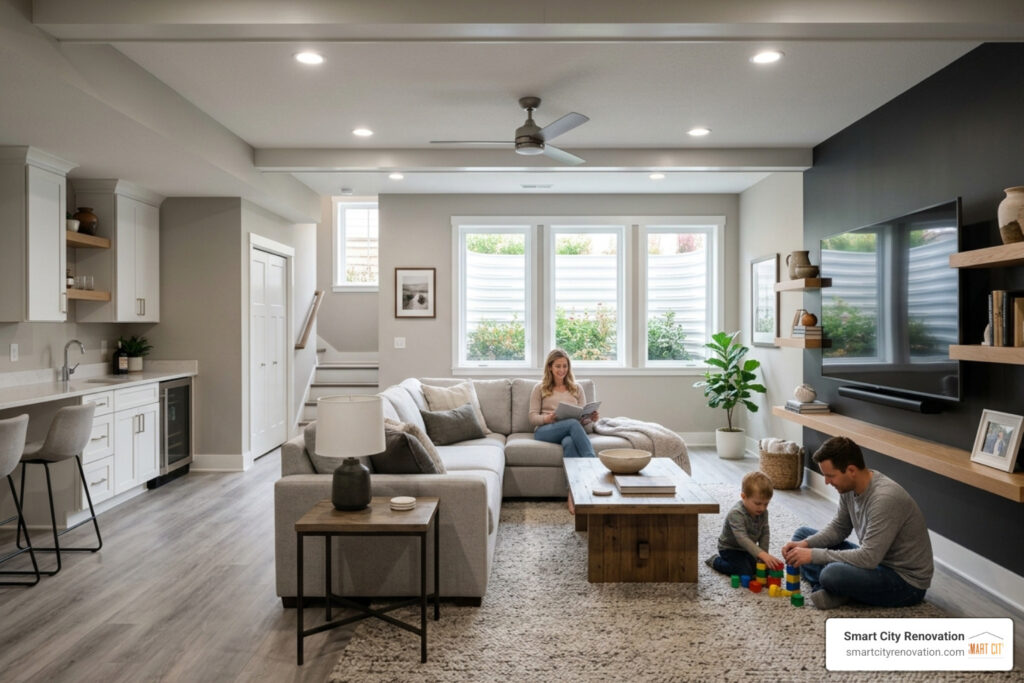
What Is Basement Remodeling — and Is It Worth It in 2026?
Basement remodeling is one of the smartest home improvement investments you can make right now. Here’s a quick overview of what it involves and what you can expect:
| Topic | Quick Answer |
|---|---|
| What it is | Converting or upgrading a below-grade space into livable, functional square footage |
| Average cost | $25–$65/sq ft to finish; $40,000–$90,000 for a full gut remodel of 1,000 sq ft |
| ROI | Up to 75% return at resale; adding a bathroom alone can boost home value 10–40% |
| Timeline | 6–14 weeks with a contractor; longer for DIY |
| Permit required? | Yes, for structural, electrical, plumbing, or HVAC work |
| Top 2026 uses | Home office, family room, rental suite, home theater, gym |
Your basement is probably the most underused space in your home. Whether it’s a dark storage dump, an outdated ’90s rec room with wood paneling and drop ceilings, or just bare concrete — it has real potential. Transforming it adds livable square footage without building an addition, and at a fraction of the cost.
The challenge? Basements come with unique problems: moisture, low ceilings, limited light, and strict building codes. Get it wrong, and you’ll be tearing it out in a few years. Get it right, and you’ve added genuine value to your home.
This guide walks you through everything — from planning and permits to materials, costs, and 2026 design trends.
I’m Norbert, a general contractor with 25 years of basement remodeling experience across the Chicagoland area, serving homeowners in Des Plaines, Chicago, Park Ridge, and beyond. I’ve seen every mistake in the book — and I’ll help you avoid them all.
Planning Your Basement Remodeling Project: Finishing vs. Remodeling
Before we swing a single hammer in your Mount Prospect or Park Ridge home, we need to define exactly what we’re doing. In the industry, we often hear homeowners use “finishing” and “remodeling” interchangeably, but they represent different levels of investment and labor.
Basement Finishing is the process of taking a “blank slate” — a raw, unfinished basement with exposed studs or concrete walls — and turning it into a livable space. This usually involves framing, insulation, electrical, plumbing, and drywall. In 2026, the average cost to finish a basement ranges from $25 to $65 per square foot. For a standard 1,000-square-foot space, you’re looking at an investment of roughly $25,000 to $65,000.
Basement Remodeling, on the other hand, involves changing an already finished space. Maybe you have a basement from the 1990s with that classic (and now very dated) dark wood paneling, low drop ceilings, and questionable “mystery” carpet. Remodeling often requires a “gut” — tearing out the old materials to update the layout, improve energy efficiency, or fix hidden issues. Because of the demolition and rerouting of existing systems, basement remodeling typically costs 15% to 25% more than a fresh finish, with full gut renovations often ranging from $40,000 to $90,000.

Signs Your Basement Needs a Major Update
How do you know it’s time to call an Interior Construction Contractor? Look for these “red flags”:
- Musty Odors: That “old basement smell” is usually a sign of mildew or mold hiding behind outdated drywall or under old carpet.
- Dated Finishes: If your basement still features fluorescent box lights and wood-look paneling, it’s dragging down your home’s value.
- Poor Layout: Many older basements have “choppy” rooms or oversized hallways that waste valuable square footage.
- Moisture Damage: Warped baseboards, peeling paint, or white powdery “efflorescence” on concrete are signs that your current setup isn’t handling humidity correctly.
Defining the Basement Remodeling Scope
What do you actually want the space to be? In 2026, we are seeing a massive shift toward multi-functional zones. Instead of one giant “rec room,” homeowners in Arlington Heights and Glenview are requesting:
- The Executive Home Office: Soundproofed walls and dedicated circuits for high-end tech.
- The Custom Home Theater: Tiered seating and specialized lighting.
- The Private Gym: Reinforced flooring for heavy weights and mirrors that don’t fog up.
- The Luxury Guest or Rental Suite: Including a full bathroom and kitchenette.
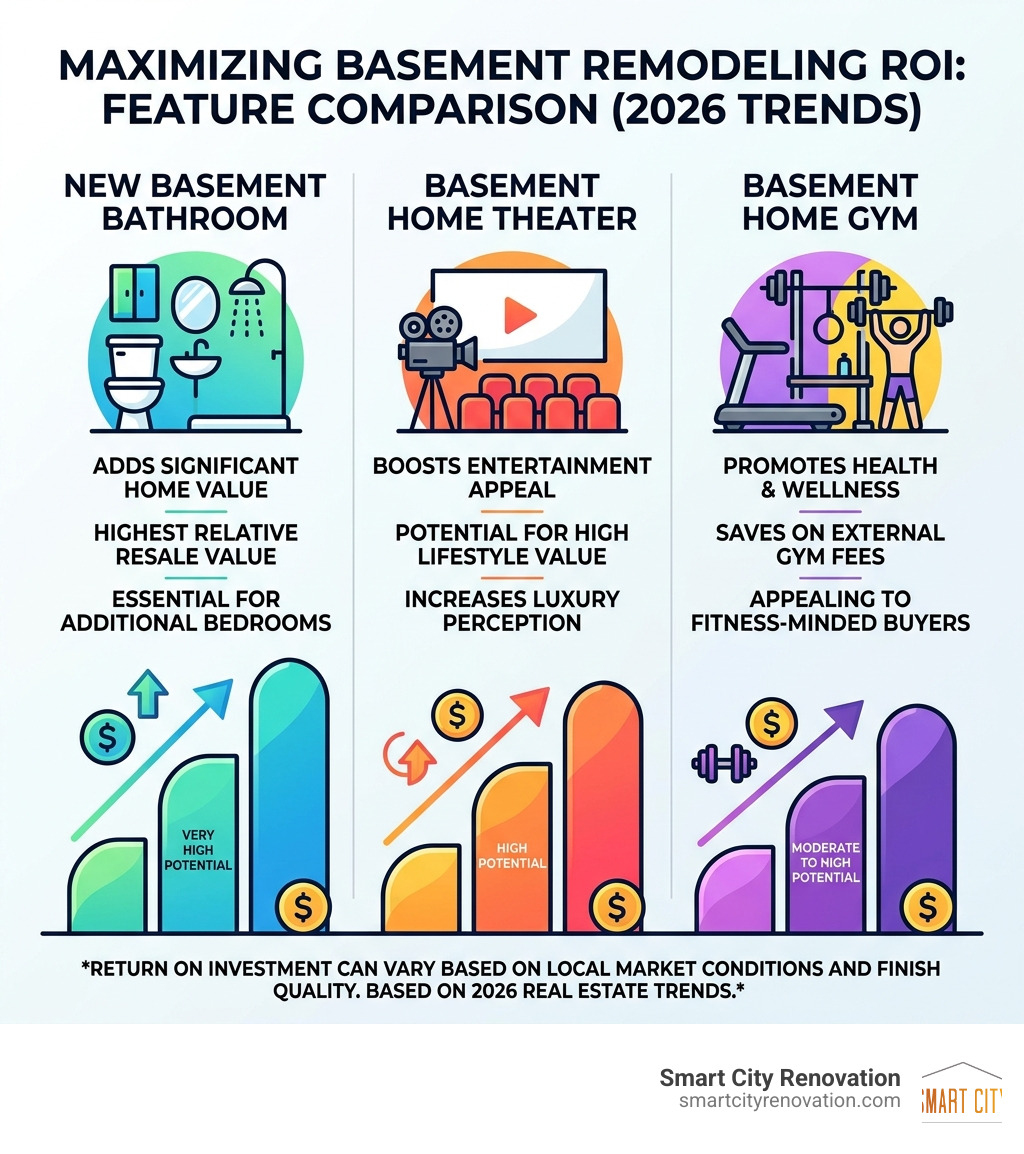
Adding a bathroom is one of the most effective ways to boost your ROI. Statistics show that an extra bathroom in the basement can increase your home’s overall value by 10% to 40%. You can explore some of our previous layout transformations on Our Work page to see how we maximize tight footprints.
Essential Steps and Building Codes for a Safe Space
When it comes to basement remodeling, “doing it right” isn’t just about aesthetics; it’s about staying legal and safe. In the Chicagoland area, including suburbs like Niles and Rosemont, we follow strict building codes based on the International Residential Code (IRC).
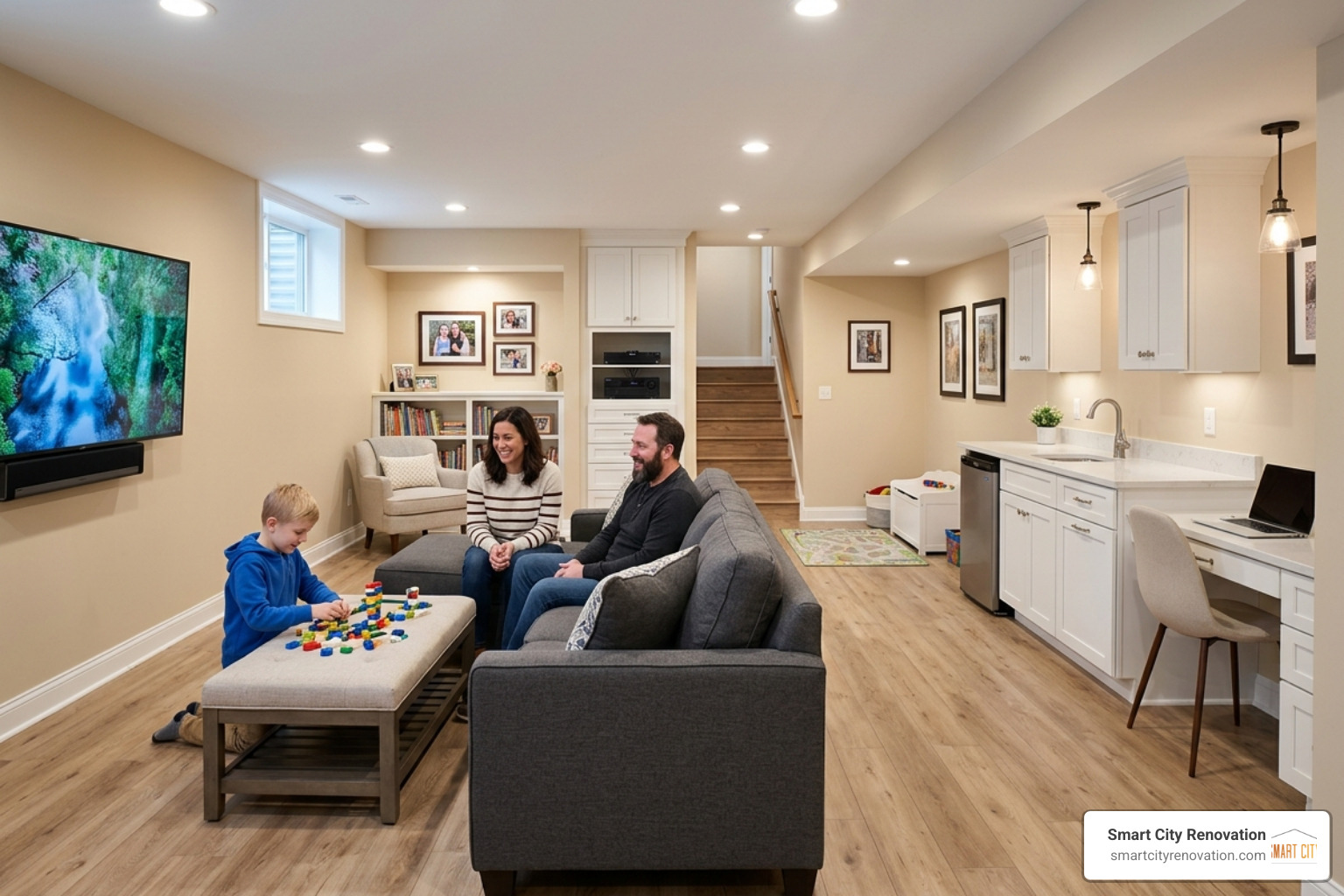
Navigating the 2026 Building Codes
- Ceiling Height: Generally, the ICC requires a minimum of 7.5 feet for habitable spaces. However, some local codes allow for 7 feet, with obstructions like beams or ducts dropping to 6 feet 4 inches.
- Egress Windows: This is non-negotiable. If you plan to have a bedroom in the basement, you must have an egress window. It needs a minimum net clear opening of 5.7 square feet and a sill height no higher than 44 inches from the floor. This is a life-safety requirement for fire emergencies.
- Fireblocking: This is a step many DIYers skip, but inspectors never do. Fireblocking involves placing fire-rated materials (like wood blocks or specialized foam) every 10 feet horizontally and at vertical transitions to prevent a fire from “chimneying” up through your walls into the attic.
- Permits: You need them. For any project involving structural changes, electrical, plumbing, or HVAC, a General Contractor must secure permits. Skipping this voids insurance coverage and makes selling your home a nightmare.
Essential Steps in the Basement Remodeling Process
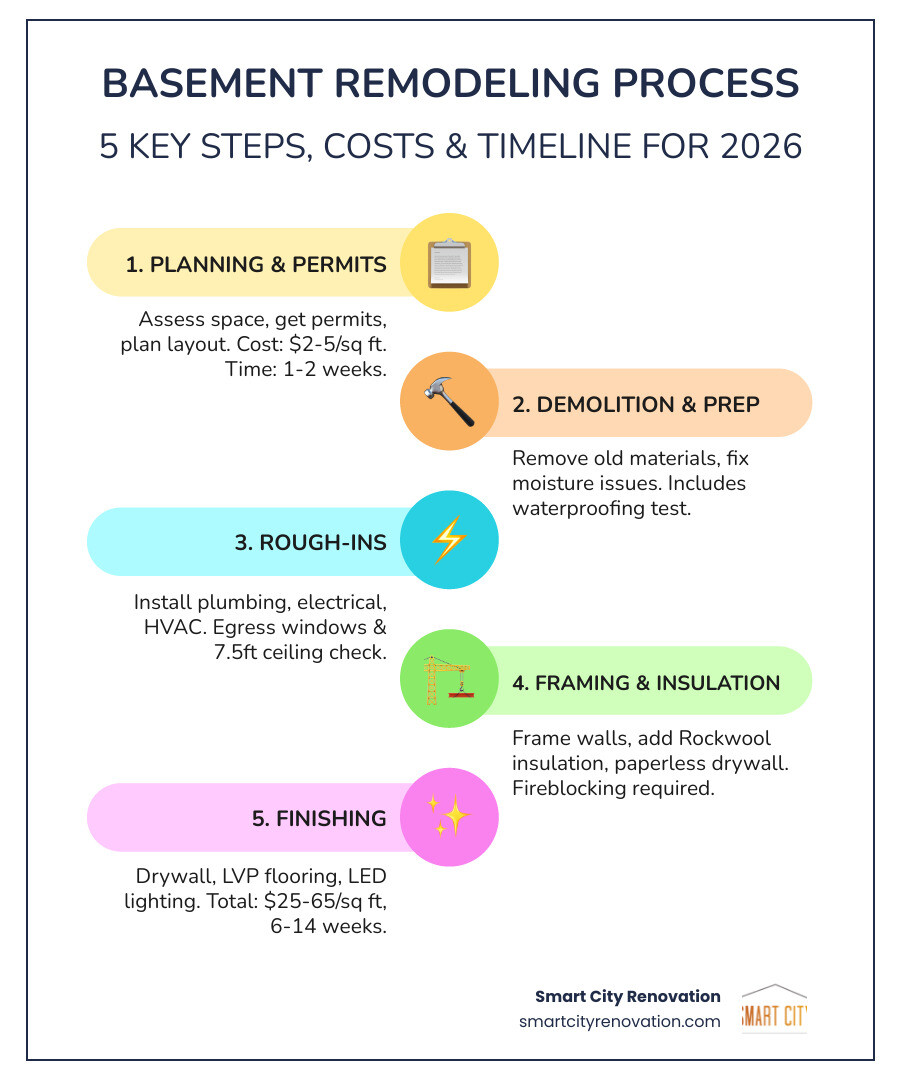
A successful project follows a very specific sequence. Here is how we typically structure a 1,000-square-foot remodel:
| Phase | Duration | Key Tasks |
|---|---|---|
| 1. Assessment & Design | 1–2 Weeks | Moisture tests, code review, floor plans |
| 2. Preparation & Demo | 1–2 Weeks | Gutting old finishes, repairing foundation cracks |
| 3. Rough-In Trades | 2–4 Weeks | Plumbing, electrical, HVAC, and egress windows |
| 4. Framing & Insulation | 1–2 Weeks | Building walls (with a slab gap) and adding rigid foam |
| 5. Drywall & Paint | 2 Weeks | Hanging paperless drywall, mudding, and priming |
| 6. Finish Carpentry | 1–2 Weeks | Flooring (LVP), trim, doors, and cabinetry |
| 7. Final Inspection | 1 Week | Final sign-off from the city |
Common Mistakes to Avoid
In my 25 years as a Remodeler, I’ve seen these three mistakes kill more projects than anything else:
- Ignoring Moisture: Never finish a basement that has active leaks. You must solve drainage issues outside (gutters, grading) before you touch the inside.
- Skipping Permits: As mentioned, it’s not worth the risk. It costs $500–$2,000 but saves you tens of thousands in potential legal or insurance headaches.
- Using the Wrong Materials: Standard wood studs and fiberglass batts against a concrete wall are a recipe for mold. We use moisture-resistant alternatives.
Moisture Control, Materials, and 2026 Design Trends
The basement environment is naturally humid, often reaching 60% humidity or higher. To ensure your basement remodeling project lasts decades, we use “science-based” construction.
The Plastic Sheet Test
Before we start, we often perform a simple 48-hour audit. We tape a 24×24-inch piece of clear plastic to the floor and walls. If condensation forms under the plastic, moisture is seeping through the foundation. If it forms on top, the room has high interior humidity. This tells us whether we need to seal the concrete or just install a high-end dehumidifier.
2026 Material Standards
- LVP Flooring: Luxury Vinyl Plank is the undisputed king of basement flooring. It is 100% waterproof. If your sump pump fails, you can literally unclick LVP, dry the floor, and click it back together.
- Paperless Drywall: We use glass-mat (paperless) drywall. Mold needs organic material (like the paper on standard drywall) to grow. By removing the food source, we eliminate the mold risk.
- Rockwool Insulation: Unlike fiberglass, Rockwool is water-repellent and fire-resistant. It provides a superior thermal break and excellent soundproofing for home theaters.
- Radon Mitigation: Chicagoland is known for radon. If testing shows levels above 4 pCi/L, we install a sub-slab depressurization system to keep your family safe, following safety standards from the Environmental Protection Agency (EPA).
Lighting: Making the “Cave” Feel Like a Suite
The biggest complaint about basements is that they feel dark. In 2026, we solve this with a “three-layer” lighting strategy:
- Ambient: Ultra-thin LED wafers that sit flush with the ceiling.
- Task: Bright pendants over a wet bar or desk.
- Accent: LED strips along baseboards or inside tray ceilings to add depth.
Frequently Asked Questions
How much does it cost to finish a basement in 2026?
Most homeowners in our service area (like Des Plaines and Schaumburg) spend between $25 and $50 per square foot. A basic finish for a 1,000-square-foot basement starts around $25,000, while a high-end custom build-out with a bathroom and wet bar can exceed $75,000.
How long does a typical basement remodel take?
A professional project typically takes 8 to 14 weeks. DIY projects often stretch into 6 months or more because of the complexity of the rough-in trades (plumbing and electrical).
Can you live in the home during construction?
Yes. Unlike a kitchen remodel where you lose your ability to cook, a basement remodel is relatively non-disruptive. There will be noise and dust, but we use strict dust-control measures to keep your main living areas clean.
Should I DIY certain aspects of the remodel?
We recommend a hybrid approach. Hire licensed professionals for the “heavy lifting” — plumbing, electrical, structural framing, and egress windows. These require permits and specialized knowledge. Once the walls are up and the inspections are passed, savvy homeowners can save 30–40% by DIYing the painting, flooring, and trim work.
Conclusion
Basement remodeling is more than just adding a room; it’s about unlocking the hidden value of your home. Whether you are in Elk Grove Village, Northbrook, or Skokie, transforming that cold concrete space into a warm, inviting living area is one of the best moves you can make for your property’s resale value and your family’s comfort.
At Smart City Renovation, we bring 25 years of Chicagoland expertise to every project. We understand the local soil conditions, the specific municipal codes of the Northwest Suburbs, and the latest 2026 design trends. From initial design to the final coat of paint, we handle the permits, the moisture control, and the craftsmanship so you don’t have to worry.
Ready to stop using your basement as a storage unit and start using it as a living space? Explore our Basement Remodeling Services or Contact Us today for a free consultation. Let’s build something incredible together.