
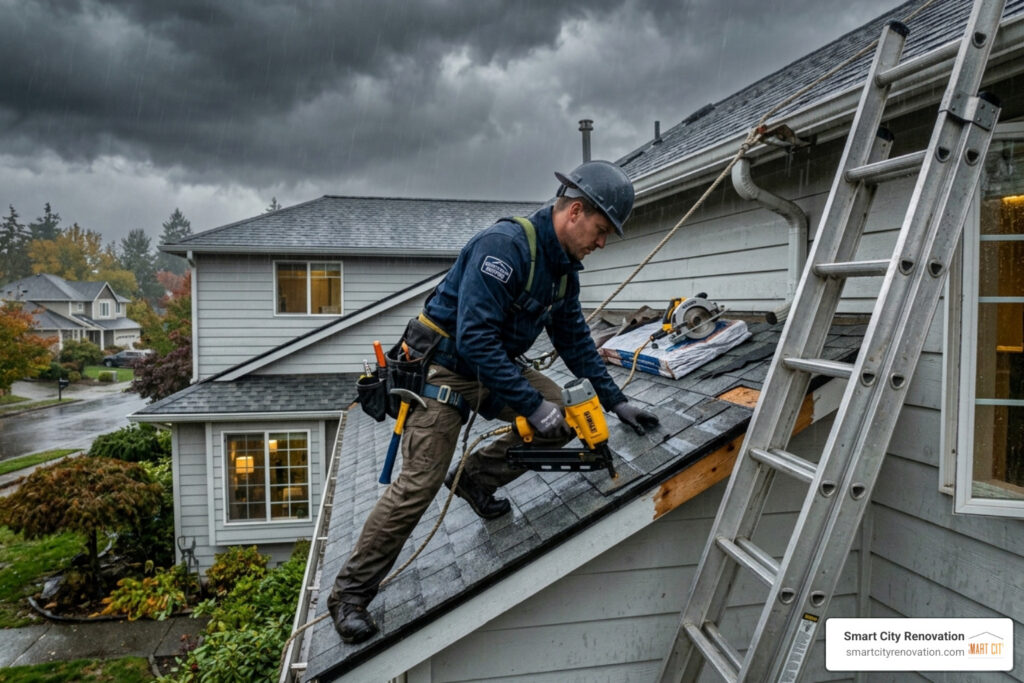
When Your Roof Can’t Wait: Getting Emergency Roofing Repair Near Me Fast
Emergency roofing repair near me is something no homeowner wants to search for — but when a storm tears through the Chicago area and water starts dripping into your living room, every minute counts.
Here’s what to do right now:
- Call a 24/7 emergency roofing contractor immediately — look for one with local Chicagoland experience and same-day dispatch
- Place buckets under active drips to limit interior water damage while you wait
- Document damage from the ground — take photos of missing shingles, debris, or sagging areas without climbing anything
- Do not go on the roof yourself — wet or damaged roofs cause serious falls
- Contact your insurance company to open a claim as soon as possible
The goal of emergency roofing is simple: stop water from getting in, stop damage from getting worse, and get a professional on-site fast.
The stakes are real. In 2024 alone, Washington state recorded 48 severe weather events that potentially affected nearly 370,000 homeowners’ roofs. The Chicago area faces its own version of this every storm season — high winds, hail, and heavy rain that can go from “minor leak” to “structural problem” within 24 to 48 hours. That’s also the same window in which mold can begin to grow inside your walls and ceiling, according to the EPA.
I’m Norbert, a general contractor with 25 years of Chicagoland construction experience, and emergency roofing repair near me is one of the most urgent calls we handle at Smart City Renovation — because waiting even one night can turn a $500 tarp job into a $15,000 interior restoration. In the sections below, I’ll walk you through exactly what to do, what it costs, and how to get the right help fast.
Learn more about emergency roofing repair near me:
Identifying a Roofing Emergency and When to Call for Help
Not every missing shingle is a five-alarm fire, but when the structural integrity of your home is at risk, you need to act. A roofing emergency is generally defined as any situation where water is actively entering the building or the roof structure has been compromised to the point of being unsafe.
In our 25 years serving areas like Des Plaines, Schaumburg, and Glenview, we’ve seen how quickly a small breach becomes a major headache. If you can see daylight through your attic or hear water rushing behind your drywall, you are in the “emergency” zone.
What Qualifies as an Emergency Roofing Repair Near Me?
If you are wondering whether to call for Emergency Roofing Services, look for these critical red flags:
- Active Water Intrusion: If water is dripping from the ceiling or running down walls, it can quickly find its way into light fixtures and electrical outlets, creating a fire hazard.
- Structural Failure: A sagging roofline or a visible collapse of a section of the roof requires immediate evacuation and professional stabilization.
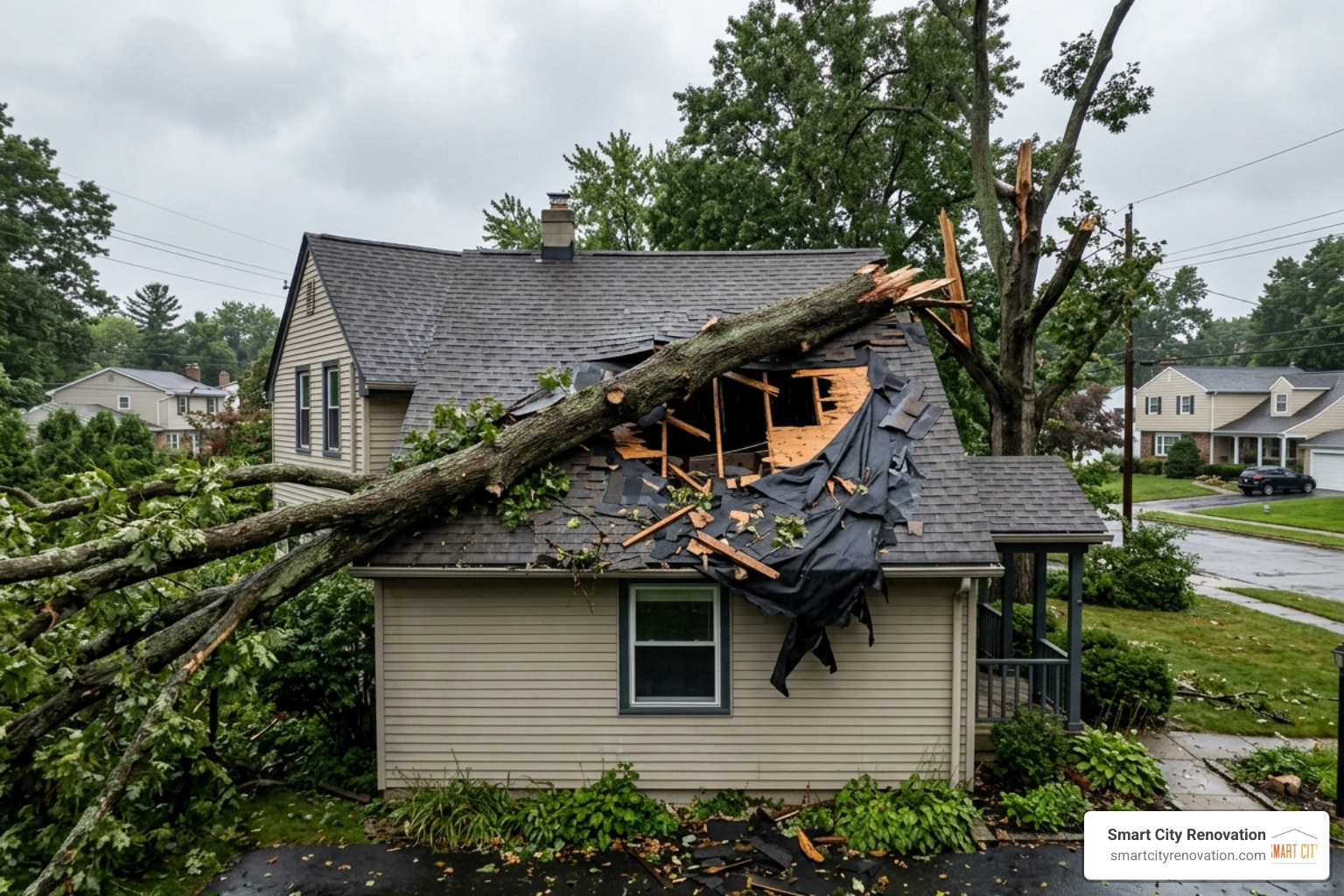
- Fallen Trees or Large Debris: When a branch or tree punches through the decking, the “envelope” of your home is broken. This isn’t just a leak; it’s a hole that lets in wind, rain, and pests.
- Fire Damage: Fire doesn’t just burn shingles; it compromises the rafters and creates holes that must be boarded up to prevent further weather damage.
- Widespread Shingle Blow-off: If a significant portion of your roof deck is exposed (you see the wood or the black underlayment), the next rain will cause massive interior damage.
Common Damage Types for Different Roof Systems
Different materials fail in different ways. Understanding your specific system helps us prepare the right materials for our services.
- Asphalt Shingles: These are prone to “wind-lift” where the seal is broken, or “hail bruising” where the protective granules are knocked off.
- Flat Roofs (TPO/EPDM/Modified Bitumen): Common in commercial buildings and some residential additions in Park Ridge or Skokie. These often suffer from “ponding” water or membrane punctures. If a flat roof fails, the weight of the standing water can lead to a collapse.
- Metal Flashing: These are the metal strips around chimneys and vents. If they are lifted by high winds, water is funneled directly into your kitchen or bedroom.
Immediate Steps for Homeowners During a Roofing Crisis
When the sky is falling (literally), panic is your worst enemy. Your priority should be safety, followed by mitigation. Mitigation is a fancy contractor word for “stopping the bleeding.”
- Safety First: If a tree has hit the house or the roof is sagging, get everyone out. Structural damage can be unpredictable.
- Utility Check: If water is leaking near your breaker box or light fixtures, turn off the power to those zones if it is safe to do so.
- Contain the Water: Use buckets or plastic bins to catch drips. If the ceiling is bulging with water, poking a small hole in the center of the bulge with a screwdriver can allow the water to drain into a bucket in a controlled way, preventing the entire ceiling from collapsing.
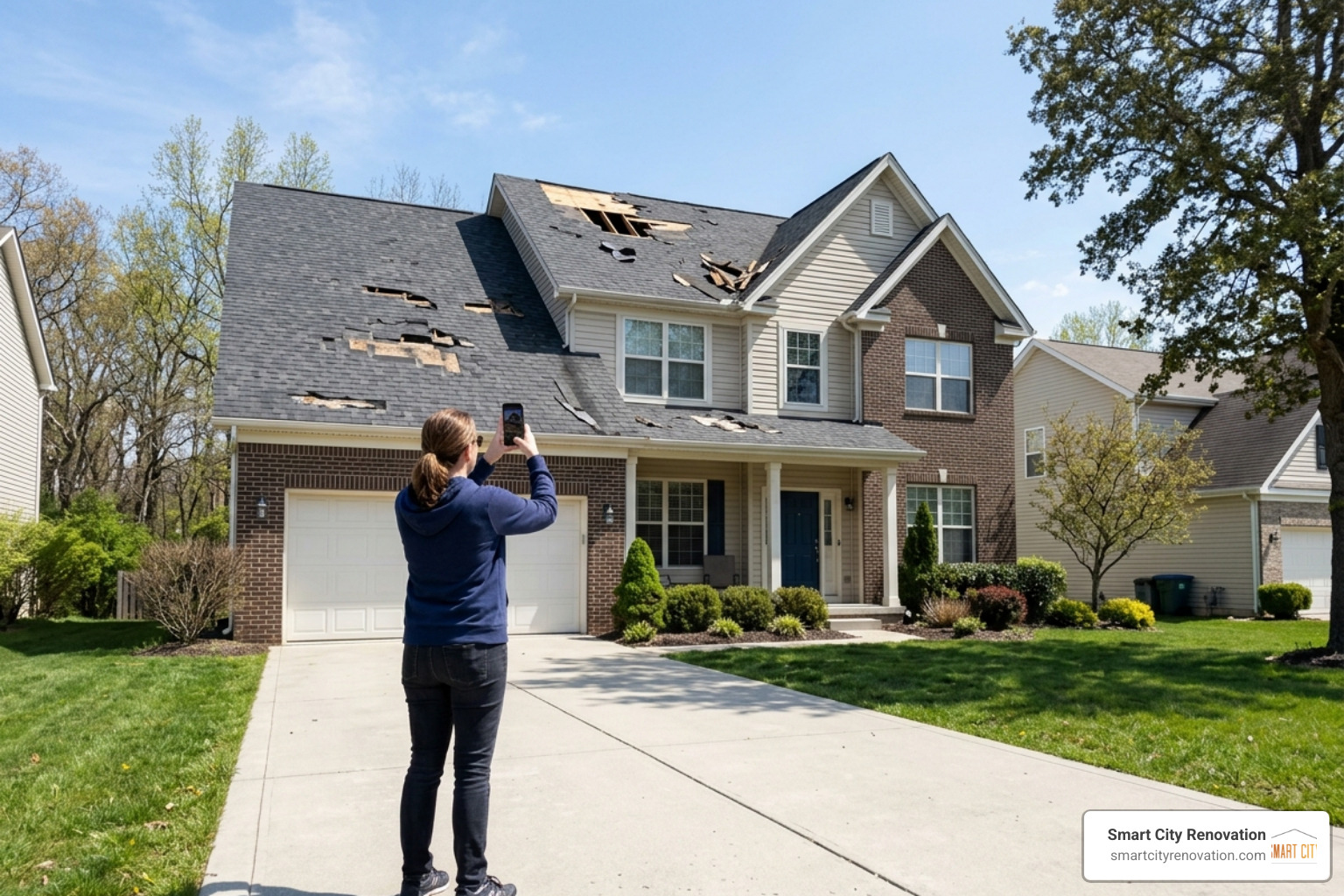
- Ground-Level Assessment: Walk around your property and take photos. Look for shingles on the lawn, bent flashing, or downed branches. This documentation is gold for your insurance claim.
What to Avoid Doing Yourself
We understand the urge to climb up there with a blue tarp and a hammer, but we strongly advise against it. Why Professional Roofers Near Me Are Worth the Investment often comes down to the simple fact of safety.
- Never climb a wet roof: Asphalt shingles become incredibly slippery when wet.
- Avoid metal ladders near power lines: Storms often knock down power lines. A metal ladder near a “live” wire is a recipe for disaster.
- Don’t attempt DIY tarping during the storm: High winds can catch a tarp like a sail, pulling you off the roof.
- Stay off compromised decking: If a tree has hit the roof, the wood underneath may be cracked. Stepping on it could cause you to fall through into the attic.
How to Find Reliable Emergency Roofing Repair Near Me 24/7
In the middle of a crisis, every “contractor” with a truck might show up in your neighborhood. Be careful. In May 2026, we are still seeing “storm chasers” who take deposits and disappear.
Look for these credentials:
- Local Expertise: A company based in the Chicagoland area (like our teams in Arlington Heights or Morton Grove) knows the local building codes and weather patterns.
- BBB Ratings: Check for an A+ rating on the Better Business Bureau to ensure they have a history of resolving customer issues.
- 24/7 Dispatch: Ensure you are talking to a real person or a monitored emergency line, not just a voicemail box that won’t be checked until Monday morning.
- Proper Licensing: In Illinois, roofing contractors must be licensed by the state. This isn’t optional.
Professional Emergency Response: Services and Costs
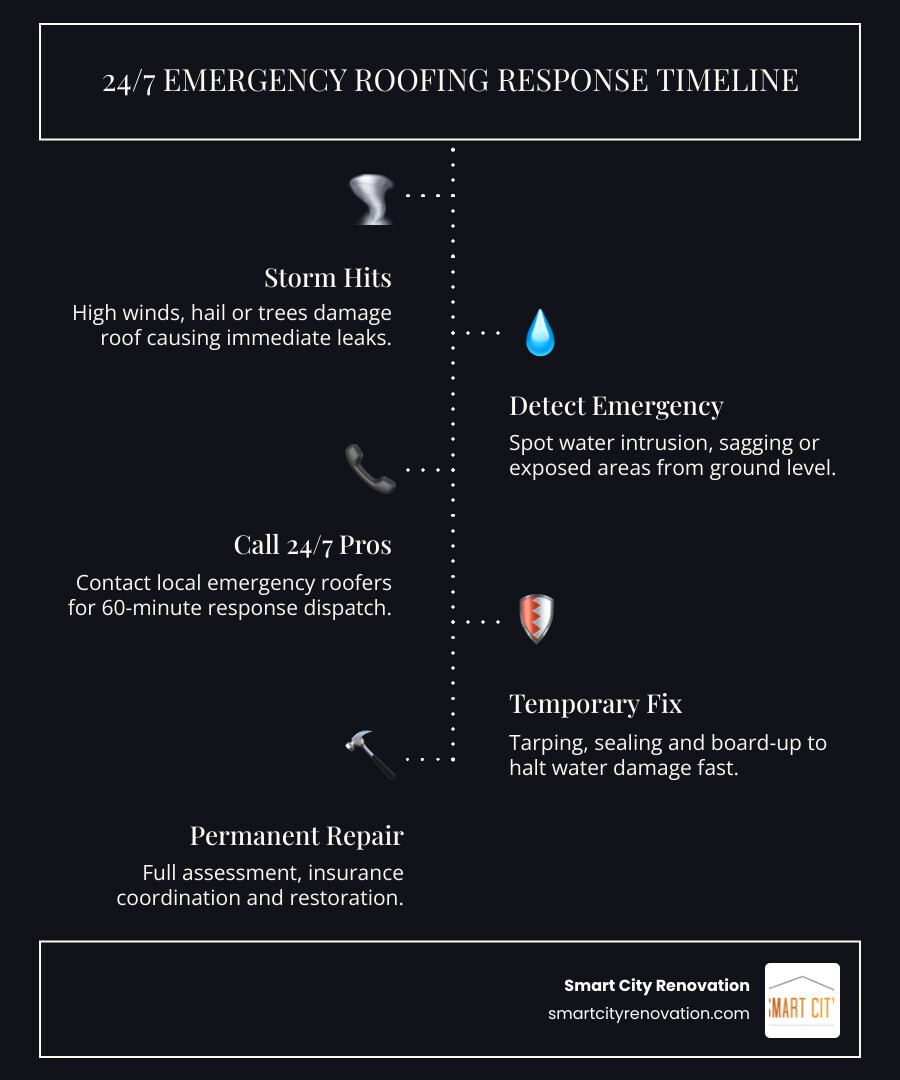
When you call for emergency roofing repair near me, the first goal isn’t a beautiful new roof — it’s stabilization. We aim for a rapid response, often arriving within 60 to 120 minutes depending on the severity of the storm and the location (such as Elk Grove Village or Buffalo Grove).
Our crews arrive with “triage” kits: heavy-duty tarps, plywood for board-ups, roofing cement, and fasteners.
The Cost of Emergency Roofing Repair Near Me and Tarping Services
Transparency is key during a stressful time. While every job is different, here is what you can generally expect for emergency stabilization in the Chicagoland market:
| Service Type | Typical Cost Range | What’s Included |
|---|---|---|
| Emergency Tarping | $300 – $800 | Professional-grade tarp, sandbags/fasteners, and labor to secure a specific area. |
| Board-Up Services | $400 – $1,200 | Plywood and structural bracing for holes caused by trees or fire. |
| Minor Emergency Patch | $500 – $900 | Temporary sealing of flashing or small punctures using roofing mastic. |
Note: Many reputable contractors, including us, may credit the cost of the emergency tarping toward your permanent repair if you choose to move forward with the full restoration.
Credentials to Look for in a Contractor
Don’t let the “emergency” label lower your standards. You are hiring a General Contractor to protect your biggest investment.
Ensure they hold:
- High Manufacturer Ratings: Look for GAF Master Elite or CertainTeed ShingleMaster certifications. These indicate the crew has been trained to the highest industry standards.
- Insurance: They should carry at least $1 million in general liability insurance and workers’ compensation.
- Local Bonds: Communities like Deerfield require specific $5,000 contractor bonds. We maintain all necessary local registrations for our service areas, from Northbrook to Hoffman Estates.
Navigating Insurance Claims and Permanent Restoration
One of the biggest advantages of hiring a professional for emergency roofing repair near me is the assistance with insurance. Most homeowner policies cover damage from “sudden and accidental” events like wind, hail, or fallen trees.
We work directly with your adjuster to ensure nothing is missed. This includes providing:
- Detailed photo documentation of the damage.
- Satellite-based roof measurements.
- A comprehensive scope of work that meets current Illinois building codes.
Repair vs. Full Roof Replacement
Should you patch it or replace it? This is the million-dollar question.
- The 20-Year Threshold: If your roof is over 20 years old, the shingles are likely too brittle to be repaired effectively. Attempting to “tie in” new shingles to old, brittle ones often causes more leaks.
- Extent of Damage: If more than 25% of the roof is damaged, most insurance companies and building codes will lean toward a full replacement.
- Cost-Effectiveness: Sometimes, the deductible for a repair is the same as the deductible for a full replacement. In those cases, a new roof is the smarter long-term investment.
Learn more about your options: Shingle and Ready to Mingle with the Best Residential Roofers Near Me.
The Path to Permanent Repair
Once the storm has passed and the tarp is secure, we move into the restoration phase. This involves:
- Material Selection: Choosing high-quality shingles or membranes that match your home’s aesthetic.
- Structural Reinforcement: Replacing any water-damaged plywood (decking) or rafters.
- Final Inspection: Ensuring the new system is watertight and meets all local codes in towns like Mount Prospect or Niles.
- Warranty: Permanent repairs should come with a workmanship warranty. At Smart City Renovation, we stand by our 25 years of expertise.
Contact us for an assessment to start your permanent restoration.
Preventing Future Disasters: Storm Season Preparation
The best way to handle an emergency is to prevent it. While you can’t stop a tornado, you can make your roof a much harder target.
Minimizing Emergency Risks in 2026
- Pre-Season Inspections: Every spring, have a pro check for loose shingles or cracked caulk around your vents.
- Gutter Cleaning: Clogged gutters cause water to back up under your shingles, leading to rot and ice dams in the winter.
- Tree Trimming: Keep branches at least 10 feet away from your roofline. In high winds, these branches act like saws against your shingles.
- Check the Flashing: Flashing is the #1 leak point. Ensure it isn’t rusted or pulling away from the chimney.
- Wind Ratings: When it is time for a new roof, ask for shingles with a high wind rating (130 MPH+). In flat areas like Fairfield or the open plains of the Midwest, “thermal updrafts” can create localized high-wind events that shred standard shingles.
Frequently Asked Questions about Emergency Roofing Repair
How quickly can an emergency roofing team arrive?
Our target for emergency roofing repair near me is 60 to 120 minutes for the initial assessment and stabilization. During major regional storms, we triage calls based on severity—active “waterfalls” inside a home take priority over a few missing shingles on a porch.
Does homeowners insurance cover emergency tarping?
Yes, in most cases. Most policies actually require the homeowner to take “reasonable steps” to prevent further damage after a loss. Emergency tarping is considered a necessary step to mitigate further interior damage, and the cost is typically covered as part of the claim.
Can I wait until the morning to call for a leak?
We don’t recommend it. Mold can begin to colonize in as little as 24 to 48 hours. Furthermore, water trapped in your ceiling can saturate insulation, making it heavy enough to cause a sudden ceiling collapse while you are sleeping. If water is coming in, call immediately.
Conclusion
A roofing crisis is stressful, but you don’t have to face it alone. Whether you are dealing with a fallen tree in Palatine or a sudden leak in Rosemont, the key is fast, professional action.
Smart City Renovation brings 25 years of local Chicagoland expertise to every emergency. We aren’t just here to slap on a tarp; we are here to restore your peace of mind, handle the insurance headaches, and ensure your home stays dry for the next 20 years.
If you are facing a roofing emergency right now, don’t wait for the living room to become a pool. Contact your local Roofing Contractor today and let us get your home back under cover.