

When Your Roof Can’t Wait — Understanding Your Roof Replacement Financing Options
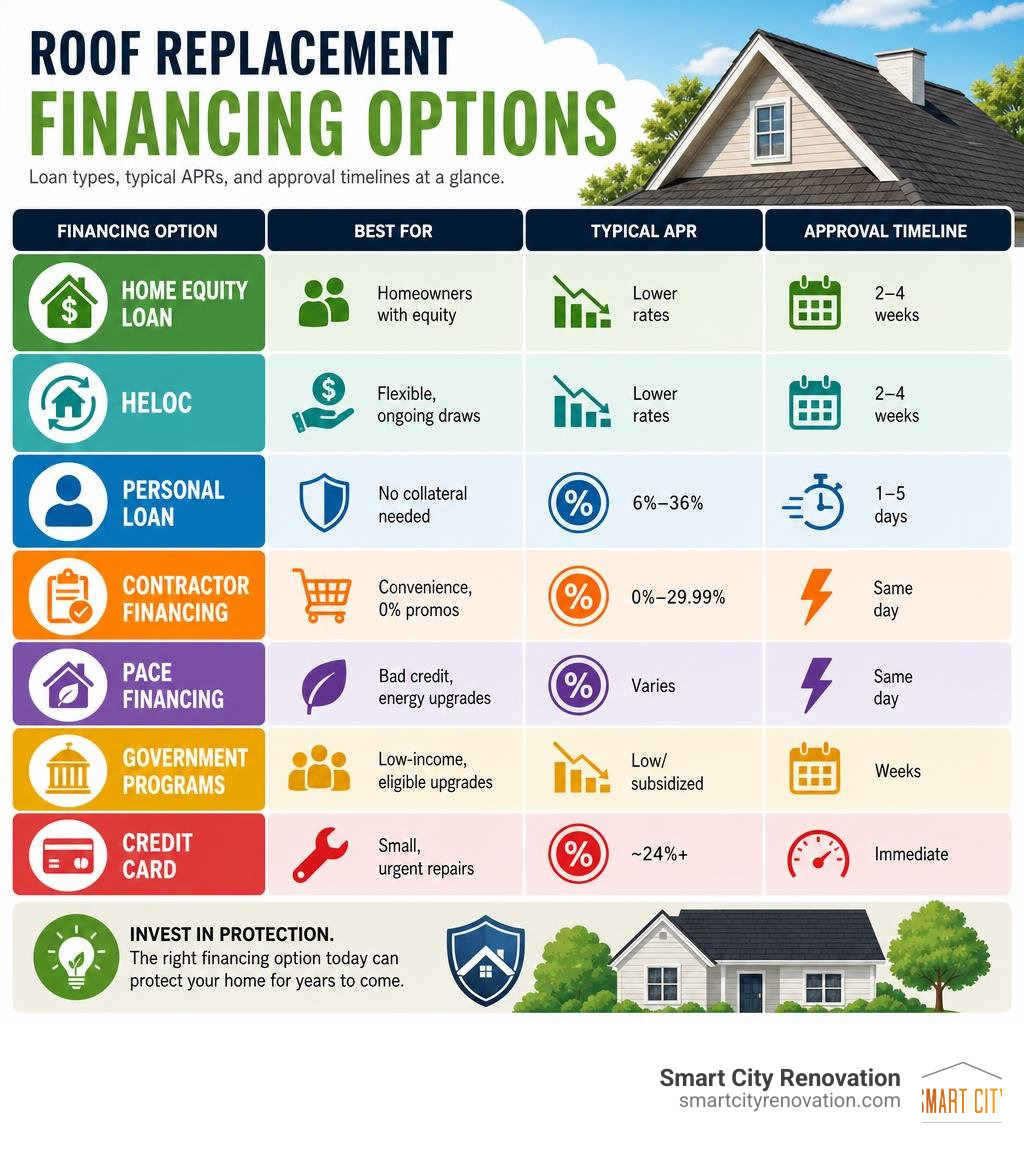
Roof replacement financing options give homeowners a way to protect their home without having to pay thousands of dollars all at once. Here’s a quick look at the most common ways to finance a new roof:
| Financing Option | Best For | Typical APR | Speed |
|---|---|---|---|
| Home Equity Loan | Homeowners with equity | Lower rates | 2-4 weeks |
| HELOC | Flexible, ongoing draws | Lower rates | 2-4 weeks |
| Personal Loan | No collateral needed | 6%–36% | 1-5 days |
| Contractor Financing | Convenience, 0% promos | 0%–29.99% | Same day |
| PACE Financing | Bad credit, energy upgrades | Varies | Same day |
| Government Programs | Low-income, eligible upgrades | Low/subsidized | Weeks |
| Credit Card | Small, urgent repairs | ~24%+ | Immediate |
The average roof replacement costs around $9,500 — and can climb past $45,000 for premium materials. That’s not a number most Chicago-area homeowners have sitting in a savings account. And unlike a kitchen remodel, a failing roof can’t wait for the perfect financial moment. Water damage, mold, and structural decay compound fast.
One couple in Florida found themselves staring at a $30,000 roofing bill with no savings to cover it. They’re not alone — and that’s exactly why knowing your options before the leak starts matters.
I’m Norbert, a general contractor with 25 years of Chicagoland construction experience at Smart City Renovation, and I’ve helped hundreds of homeowners navigate roof replacement financing options alongside the actual work of getting a new roof installed right. In the sections below, I’ll break down every major financing path — rates, risks, timelines, and all — so you can make a clear-headed decision.
Must-know roof replacement financing options terms:
Comparing Your Primary Roof Replacement Financing Options
When your roof starts showing signs of wear and tear, or after a severe Chicagoland storm sweeps through, you need to act fast. But how you pay for that project depends heavily on your financial health, your home equity, and how quickly you need the funds.
Let’s look at a head-to-head comparison of the primary ways homeowners fund their roofing projects in 2026:
| Financing Type | Collateral Required? | Typical Repayment Terms | Funding Speed | Primary Risk |
|---|---|---|---|---|
| Home Equity Loan | Yes (Home) | 5 to 30 years | 2 to 4 weeks | Foreclosure if you default |
| HELOC | Yes (Home) | 10-year draw, 20-year repay | 2 to 5 weeks | Foreclosure; variable rates can rise |
| Personal Loan | No | 2 to 7 years | 1 to 5 business days | High APR for fair/poor credit |
| Contractor Financing | No (Usually) | 1 to 12 years | Same day to 48 hours | High interest after promo periods |
Choosing the right structure is about balancing speed against total long-term cost. If you need immediate protection to prevent structural rot, waiting a month for a home equity appraisal might not be an option. On the other hand, rushing into a high-interest personal loan when you have ample home equity could cost you thousands of dollars in unnecessary interest.
For a deeper look at why high-quality installation is just as critical as your payment plan, check out our guide on Why Professional Roofers Near Me Are Worth the Investment.
Home Equity Loan and HELOCs for Roof Replacement
If you have built up significant equity in your home, borrowing against it is often the most cost-effective way to fund a major capital improvement like a new roof. Because these are secured loans—meaning your home serves as the collateral—lenders take on much less risk. Consequently, they offer some of the lowest interest rates on the market.
- Home Equity Loans: This option provides a lump-sum payment with a fixed interest rate and fixed monthly payments over a term ranging from 5 to 30 years. It is ideal if you have a firm, all-inclusive estimate from your contractor and want predictable monthly costs.
- Home Equity Lines of Credit (HELOCs): A HELOC works more like a credit card. You are approved for a maximum borrowing limit and can draw funds as needed during a set “draw period” (usually 10 years), followed by a repayment period (often 20 years). This is highly useful if you are tackling a phased renovation—such as replacing the roof now and upgrading gutters or attic insulation later.
Most home equity programs limit your total borrowing to a maximum of 80% to 85% Loan-to-Value (LTV) ratio, though some specialized lenders may go higher for qualified borrowers. The biggest drawback? The application process is thorough. You will need to undergo a formal home appraisal, submit extensive tax and income documentation, and pay closing costs (typically 2% to 5% of the loan amount). Crucially, if you fall behind on payments, the lender can initiate foreclosure proceedings on your home.
Personal Loans as Unsecured Roof Replacement Financing Options
If you want to avoid risking your home as collateral, or if you simply do not have enough equity built up yet, an unsecured personal loan is an excellent alternative.
Personal loans do not require an appraisal, which dramatically slashes the time it takes to get cash in hand. Many online lenders can pre-qualify you in 60 seconds using a soft credit pull and deposit the funds directly into your bank account within 24 to 48 hours.
Because these loans are unsecured, lenders rely heavily on your credit profile to determine your interest rate. Borrowers with excellent credit (FICO scores of 720 or higher) can unlock highly competitive fixed rates. However, personal loan APRs span a wide spectrum—from roughly 6% up to 36%. If your credit score sits below 650, you can expect to pay rates on the higher end of that scale, which can make the long-term cost of the roof significantly more expensive.
To explore what current nationwide rates look like, you can review the Best Roof Financing Options in 2026 – NerdWallet or check out alternative lending structures at Financing Options for Your Remodeling & Re-Roof.
Contractor Financing and Promotional Payment Plans
Many professional roofing companies partner with third-party home improvement lenders to offer financing directly at the kitchen table. This is incredibly convenient: your contractor handles the paperwork, submits the application, and gets a decision within minutes.
Contractor financing often features attractive promotional terms, such as:
- 12-Month “Same-as-Cash” Plans: You pay 0% interest as long as you pay off the entire balance within the first year.
- Low-Interest Installment Plans: Fixed monthly payments over 5 to 10 years at a stable interest rate (such as 6.99% APR).
However, you must read the fine print carefully. Many 0% promotions use “deferred interest.” This means if you have even a $50 balance remaining when the 12-month promotional window closes, the lender retroactively charges you interest on the entire original loan amount from day one. Additionally, some contractors build “dealer fees” into their project estimates to offset the cost of offering these low rates. Always ask for a cash price comparison before signing.
You can find more details on how these platforms operate by checking out Roofing Financing Options – Hearth.
If you live in our local service areas, you can also look into localized installation options to match your budget:
- Des Plaines Roofing Contractors: Fast Repairs & Installations
- Mount Prospect Roofing Contractors: Repair & Replacement
- Expert Roofing Contractors in Niles, IL | Infinity Exteriors
- Roofing Contractors Serving Arlington Heights, IL | Infinity Exteriors
- Roofing Contractors in Morton Grove, IL | Infinity Exteriors
How PACE Financing Works for Roof Replacement
Property Assessed Clean Energy (PACE) financing is a unique alternative to traditional bank loans. Instead of evaluating your personal credit score or debt-to-income ratio, PACE programs qualify you based on the equity in your home, your mortgage payment history, and the property tax status of your home.
Under a PACE program, the financing company funds 100% of the cost of your roof replacement upfront. You then repay the balance over a long term (up to 30 years) through a special assessment added directly to your property tax bill.
Because the loan is tied directly to the property rather than you personally, it is structured as a tax lien on the home. This makes it highly accessible for homeowners who may have poor credit but possess substantial home equity.
Key Benefits of PACE Roof Replacement Financing Options
- No Upfront Costs: You can replace a failing, energy-inefficient roof with $0 down.
- Accessible Qualification: Approval does not depend on a high FICO score, making it a viable lifeline for retirees, self-employed individuals, or those recovering from financial setbacks.
- Long Repayment Windows: Spreading the cost over 20 to 30 years keeps the annual property tax increase manageable.
- Transferability: In theory, because the assessment is tied to the physical property, the remaining debt can transfer to the next homeowner if you sell the house.
Drawbacks and Risks of PACE Programs
While PACE sounds like the perfect solution, it carries significant risks that every homeowner should weigh carefully:
- Selling Obstacles: In practice, most mortgage buyers and major secondary market lenders (like Fannie Mae and Freddie Mac) will not purchase a mortgage on a home with an outstanding PACE lien. Consequently, if you sell your home, you will almost certainly be forced to pay off the entire remaining PACE balance at closing.
- Refinancing Hurdles: Refinancing your traditional mortgage can be incredibly difficult because the PACE tax assessment takes “first-lien” priority over your bank mortgage.
- Higher Interest Rates: PACE interest rates are often higher than traditional home equity loans or HELOCs.
- Risk of Tax Foreclosure: Because the payment is part of your property taxes, failing to pay your PACE assessment can lead to tax foreclosure by your local county, which is often a much faster process than a standard bank foreclosure.
Key Financial Factors: Credit, Liens, and Timelines

Before you pull the trigger on any financing option, it is essential to understand the mechanics of how these loans interact with your credit, your property’s legal title, and your project’s timeline.
Credit Score Requirements and Bad Credit Alternatives
Your FICO score is the primary gatekeeper for traditional loans. Here is a general breakdown of what your credit score unlocks when shopping for unsecured personal loans or contractor financing:
- Excellent Credit (720 – 850): Unlocks the lowest interest rates (6% to 12% APR), maximum borrowing limits (up to $100,000), and flexible repayment terms.
- Good Credit (680 – 719): Strong approval rates with competitive APRs (12% to 19.99%). You will easily qualify for most standard promotional plans.
- Fair Credit (620 – 679): Higher APRs (20% to 29.99%). You may face lower maximum loan limits and shorter repayment windows.
- Poor Credit (550 – 619): Traditional unsecured options are limited and expensive (often exceeding 30% APR).
If your credit is in the fair-to-poor range, do not panic. You can still explore alternative paths:
- Co-signers: Adding a family member with strong credit can help you qualify for lower rates.
- Secured Loans: Applying for a home equity product or a cash-out refinance leverages your home’s value rather than just your credit score.
- Subprime Contractor Platforms: Some multi-lender contractor financing networks work with specialized subprime lenders who approve borrowers down to a 550 FICO score.
Timelines for Approval and Funding
The urgency of your roofing needs should dictate your financing choice. If water is actively pouring through your ceiling, you cannot afford to wait weeks for a bank’s underwriting department.
- Fastest (Same Day to 48 Hours): Contractor financing, personal loans, and credit cards. These options rely on automated digital underwriting and soft credit pulls for instant pre-qualification.
- Moderate (3 to 5 Business Days): Unsecured online personal loans that require manual document verification (like submitting W-2s or tax returns).
- Slowest (2 to 6 Weeks): Home equity loans, HELOCs, and cash-out refinances. These products require home appraisals, title searches, and formal closing procedures.
If you are dealing with an active emergency, read our The Homeowner’s Guide to Fixing That Pesky Roof Leak to protect your property while your financing application is processed.
Tax Deductibility, Liens, and Total Cost Factors
Many homeowners assume that any interest paid on a home improvement loan is tax-deductible. Under current IRS guidelines, interest on home equity loans and HELOCs is only deductible if the funds are used to “buy, build, or substantially improve” the taxpayer’s home that secures the loan. Because a complete roof replacement extends the useful life of your home, it generally qualifies. However, interest on unsecured personal loans or standard credit cards is never tax-deductible. Always consult a certified tax professional to verify your specific situation.
Another critical legal detail is the mechanic’s lien. In Illinois, any contractor, subcontractor, or material supplier who works on your home has the right to file a mechanic’s lien against your property if they are not paid. When utilizing contractor financing, the lender typically pays the contractor directly once you sign off on the completed work. To protect yourself, always request a signed lien waiver or lien release form from your contractor as soon as the project is paid in full. This prevents any future cloud on your property’s title.
Frequently Asked Questions About Funding Your New Roof

Can I finance a roof replacement with no down payment?
Yes! Many of the most popular roof replacement financing options are structured with $0 down. Unsecured personal loans, contractor promotional programs (like 12-month same-as-cash), and PACE programs all offer 100% project financing. This means you do not have to pay a single penny out of pocket to get your project scheduled and completed. Your first monthly payment is typically not due until 30 to 60 days after the installation is complete.
Are there state-specific programs in California, Florida, or Illinois?
Yes, geographic location plays a major role in your financing options:
- California and Florida: These states have robust, statewide PACE programs (such as Home Run Financing) designed to help homeowners fund energy-efficient roofs and hurricane-mitigation upgrades. Florida also offers localized wind-mitigation grants that can be paired with financing.
- Illinois (Chicagoland): While residential PACE is less common here, Illinois homeowners have access to unique preservation programs. For historic properties—such as vintage bungalows or greystones in our service areas like Niles, Glenview, or Evanston—the Illinois Property Tax Assessment Freeze can freeze your property tax assessment for up to 12 years if you perform a qualifying historic rehabilitation. Additionally, local weatherization assistance programs provide grants and low-interest loans for energy-efficiency improvements to low-income households.
Will homeowners insurance cover my roof replacement?
Homeowners insurance is designed to cover sudden, accidental damage caused by covered perils—such as severe hail, windstorms, or a falling tree branch during a Chicago winter storm. It does not cover normal wear and tear or neglect. If your roof is simply 25 years old and has reached the end of its natural lifespan, insurance will not pay for the replacement.
If you do have a valid insurance claim, you can use financing to bridge the gap. For example, you can finance your deductible, or utilize a short-term, low-interest loan to pay the contractor upfront while you wait for the insurance company to release your claim check (which can sometimes take several weeks).
To learn more about identifying damage and managing repairs, check out The Ultimate Guide to Roof Repair and our localized resource on Expert Roof Repair in Des Plaines: Restoring Your Home’s Protection.
Conclusion
A failing roof is not a problem that gets better with time. Delaying a replacement to save up cash can lead to mold growth, damaged insulation, ruined drywall, and compromised structural framing—ultimately costing you far more than the interest on a structured loan.
At Smart City Renovation, we have spent 25 years helping homeowners across Chicagoland—from Des Plaines and Mount Prospect to Niles, Arlington Heights, and Morton Grove—protect their greatest investments. We understand that navigating roof replacement financing options can feel overwhelming, but you do not have to do it alone.
Whether you are looking for a flexible payment plan, a low-interest personal loan, or want to explore how to combine insurance claims with financing, our experienced team is here to guide you through every step of the process.
Ready to secure your home with a beautiful, durable new roof? Contact our expert roofing contractors today to schedule your comprehensive roof assessment and explore our flexible payment plans.