
What Does a Bathroom Addition Actually Cost in 2026?
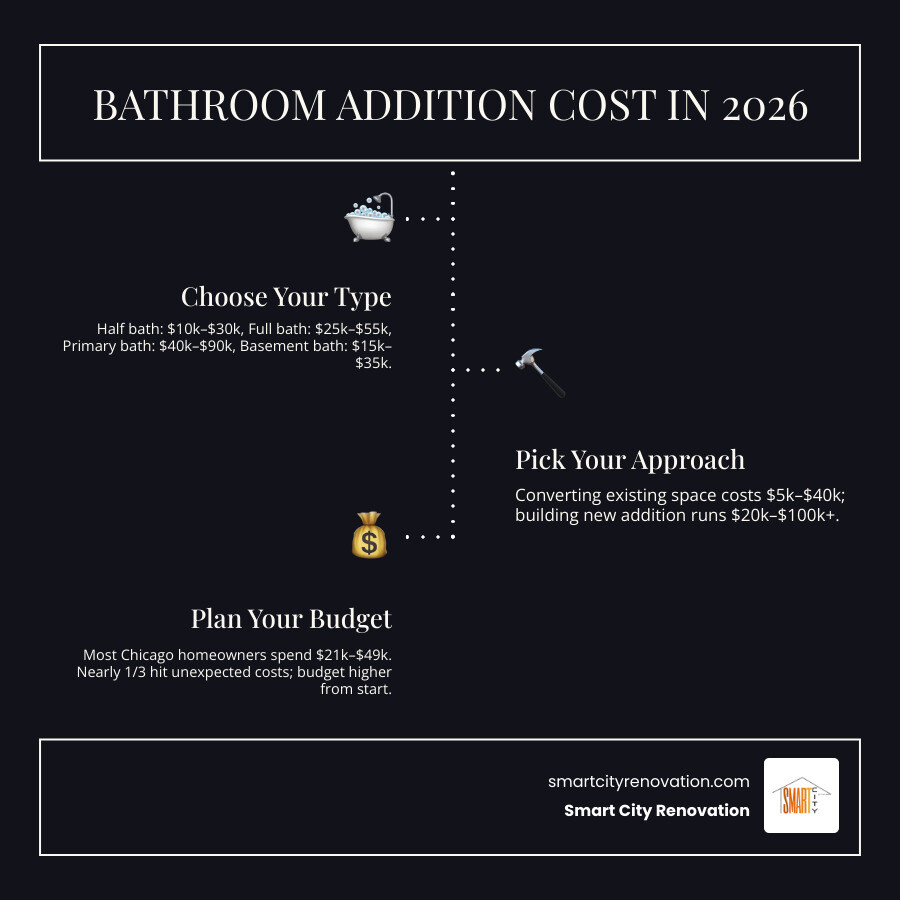
Bathroom addition cost in 2026 ranges from $15,000 to $90,000, depending on the size, type, location, and finish level of the project. Here’s a fast snapshot to answer the most common question right away:
| Bathroom Type | Typical Cost Range |
|---|---|
| Half bath / powder room | $10,000 – $30,000 |
| Full bathroom | $25,000 – $55,000 |
| Primary / master bathroom | $40,000 – $90,000 |
| Basement bathroom | $15,000 – $35,000 |
| Converting existing space | $5,000 – $40,000 |
| Building a new addition | $20,000 – $100,000+ |
Most homeowners in the Chicago area land somewhere in the $21,000 to $49,000 range for a standard addition. Converting an existing space — like a laundry room or large closet — is almost always cheaper than building out new square footage, sometimes by as much as 50%.
Adding a bathroom is one of the most complex home improvement projects you can take on. It touches plumbing, electrical, ventilation, structural work, and permits — all at once. Nearly one-third of homeowners hit unexpected costs mid-project, and 23% said afterward they wished they had budgeted higher from the start.
This guide walks you through every major cost factor so you can plan realistically before a single wall gets opened.
I’m Norbert, lead contractor at Smart City Renovation, with 25 years of hands-on experience managing bathroom addition costs across Chicago, Park Ridge, Des Plaines, and the surrounding suburbs. Everything in this guide reflects what we actually see on job sites — not just national averages.
Must-know bathroom addition cost terms:
Average Bathroom Addition Cost in 2026
When planning your budget, the first fork in the road is deciding whether you are converting an existing room or building an entirely new structural extension.
According to data from How Much Does It Cost to Add a Bathroom in 2026? | Fixr.com , the national average complete project cost sits right around $40,000. However, in our local Chicagoland market — including high-demand areas like Glenview, Arlington Heights, and Northbrook — complex local building codes and professional labor rates typically push the average slightly higher. For a detailed local cost perspective, you can read our breakdown on What Will Your Chicago Bathroom Remodel Cost.
Here is how the numbers shake out when comparing the two major routes per square foot:
- Repurposing Existing Space (Conversion): $200 – $300 per square foot for a standard finish. If you want high-end luxury, expect $450 – $600 per square foot.
- Building a New Addition (Extension): $400 – $550 per square foot for standard builds, and upwards of $850 – $1,200+ per square foot for high-end primary suites.
The reason extensions cost so much more is simple: you are building a mini-house. You have to pour a foundation, frame exterior walls, run a roofline, install siding, and hook up insulation. With a conversion, you already have the “envelope” of the room; you are just configuring the inside.
Conversion vs. New Addition Cost Comparison
| Project Phase | Conversion (Existing Space) | New Extension (Ground-Up Build) |
|---|---|---|
| Foundation & Framing | $0 – $1,500 (minor framing) | $3,000 – $15,000+ |
| Plumbing Rough-In | $3,500 – $8,000 | $5,000 – $12,000+ |
| Electrical Work | $500 – $1,500 | $1,500 – $2,500+ |
| Permits & Inspections | $200 – $1,000 | $800 – $2,500+ |
| Finishes & Fixtures | $3,000 – $15,000 | $5,000 – $25,000+ |
| Total Estimated Cost | $5,000 – $35,000 | $20,000 – $75,000+ |
Regardless of which path you choose, small bathrooms (under 40 square feet) do not benefit much from economies of scale. The fixed costs — like buying a toilet, a sink, and hiring a licensed plumber to run the main lines — remain exactly the same whether your bathroom is tiny or spacious.
Cost Breakdown by Bathroom Type and Layout
The type of bathroom you choose to build dictates your starting budget. Every square foot you add requires more drywall, more tile, and more labor. Furthermore, the complexity of your plumbing layout will drastically shift the final invoice.
Let’s look at how costs differ based on the specific layout you want to install.
Half Bath and Powder Room Bathroom Addition Cost
A half bath (or powder room) typically ranges from 18 to 25 square feet and contains only a toilet and a sink. It is the most budget-friendly addition you can choose.
If you are converting a small footprint like a hallway closet, a laundry room corner, or the unused space under a staircase, a half bath conversion typically costs between $5,000 and $15,000. If we have to build a brand-new bump-out addition for it, the cost will run closer to $10,000 to $30,000.
Because guest bathrooms do not have showers or bathtubs, you do not have to worry about heavy waterproofing, tile surrounds, or massive moisture control. This keeps both material and labor costs to a minimum.
Converting the space under a staircase is one of our favorite recommendations for homeowners in older Niles or Park Ridge homes. It adds incredible convenience for guest use without eating into your active living space.
Full and Primary Bathroom Addition Cost
A standard full bathroom (typically 35 to 50 square feet) includes a toilet, sink, and a tub-shower combo. Building one of these from scratch usually runs between $25,000 and $55,000.
If you are aiming for a luxurious primary bathroom (100 to 200 square feet) complete with a double vanity, a freestanding soaking tub, a custom walk-in tile shower, and premium smart features, the budget typically scales from $40,000 to $90,000+. For a comprehensive look at what goes into planning these larger layouts, check out The Ultimate Guide to Bathroom Remodeling.
At around 100 square feet, you hit the “sweet spot” for a primary bathroom. This size allows enough clearance for a double vanity and a separate water closet without making the room feel like an obstacle course. However, because primary suites require premium finishes — like quartz countertops and extensive custom tile work — finishes will quickly make or break your budget.
Basement Bathroom Additions
Basements are a natural choice for adding a bathroom, especially if you are finishing the space for an in-law suite or recreation room. However, they come with unique structural challenges that can add $5,000 to $15,000 to the cost of an above-grade addition.
First, your contractor has to jackhammer through the concrete slab foundation to lay the new drain lines. Second, because basement drains sit below your home’s main sewer line, gravity won’t do the work for you. You will need to install a sewage ejector pump system, which typically costs $1,500 to $4,000 installed, to pump waste upward against gravity.
To learn more about the step-by-step process of managing these concrete-heavy plumbing requirements, read our specialized guide on From Concrete to Commode Building a Bathroom in Your Basement.
Key Factors That Impact Your Total Budget

Understanding where your money goes is crucial to keeping your project on track. In a standard bathroom addition, labor represents a massive portion of your spend — typically 40% to 55% of the total budget.
Here is a breakdown of the key elements that dictate your final cost:
- Plumbing Proximity & Wet Walls: The single biggest money-saver is placing your new bathroom back-to-back or directly above/below an existing one. This allows us to share the existing plumbing stack (the “wet wall”). Splicing into an existing wet wall can save you $3,000 to $8,000 in plumbing labor and pipe runs.
- Plumbing Rough-In: If we have to run brand-new supply and drain lines across the house, plumbing rough-ins alone can cost $4,000 to $15,000. Drain lines are much harder to install than supply lines because they must maintain a strict downward slope of at least 1/4-inch per foot to function.
- Electrical Upgrades: Modern building codes (NEC) are strict. Bathrooms require their own dedicated 20-amp circuits, and GFCI outlets must be installed within six feet of any water source. If your home’s electrical panel is already maxed out, you may need a panel upgrade (e.g., upgrading to 200-amp service), which adds $2,000 to $4,000 to your budget.
- Structural Changes: If your addition requires cutting into load-bearing walls, reinforcing floor joists to support a heavy, water-filled bathtub (which can weigh up to 1,000 lbs when full), or modifying your roofline, expect structural fees to rise.
- Permits & Inspections: Skipping permits to save a few hundred dollars is a massive mistake that can halt your project or ruin a future home sale. In Chicagoland suburbs like Schaumburg, Skokie, and Des Plaines, municipal permits and inspections for plumbing, electrical, and structural work typically cost between $500 and $2,500.
Return on Investment and Resale Value

Is adding a bathroom worth the investment? The short answer is yes — especially if your home currently has a high bedroom-to-bathroom ratio.
Adding a second bathroom to a three-bedroom, one-bath home is one of the most profitable renovations you can make. It fundamentally changes how the home functions, making it appeal to a much wider pool of buyers. According to the National Association of Home Builders (NAHB), adding a highly requested second bathroom can increase your home’s overall value by 10% to 30% (roughly a $20,000 to $50,000 value boost).
According to the Remodeling Magazine Cost vs. Value report, a midrange bathroom addition recoups about 53% of its cost at resale, while an upscale, luxury addition recoups roughly 36%.
For more perspective on how these returns stack up nationally, you can check out How Much Does It Cost To Add a Bathroom? (2026 Guide) .
What Do Buyers Actually Want?
If you are remodeling with resale value in mind, align your project with current buyer preferences. The NAHB reports that the most-wanted bathroom features among buyers are:
- A linen closet in the primary bath (76% find this essential or desirable)
- A separate shower stall and tub in the primary bath (74%)
- A double vanity (69%)
- A private water closet / toilet room (67%)
Keep your design choices timeless. Opt for neutral color palettes, classic subway tiles, and durable quartz countertops. Avoid ultra-trendy brass finishes that may tarnish or go out of style quickly; stick to classic brushed nickel or chrome instead.
Smart Ways to Save Money on Your Project
You don’t have to blow past your budget to get a beautiful, functional bathroom. Here are our top insider strategies to keep your bathroom addition cost under control:
- Preserve the Layout: Never move your toilet or shower drain once they are set. Keeping fixtures in their original proposed plumbing footprint can save you $1,500 to $4,000 in labor.
- Choose Stock Over Custom: A high-quality, pre-fabricated stock vanity can look incredibly high-end when paired with premium hardware and a remnant piece of quartz or granite. This can save you thousands compared to a custom-built cabinet.
- Use Accent Tiles Strategically: Love expensive, hand-painted stone tile? Don’t tile the whole shower with it. Use affordable ceramic subway tile ($7 to $15 per square foot) for the main walls, and use your premium stone tile solely as an accent inside the shower niche.
- Do Your Own Finishing Work: Let the licensed professionals handle the plumbing, electrical, and structural framing. But when it comes to painting, installing bath hardware, hanging mirrors, or sealing grout, doing it yourself can save you 10% to 15% on total labor costs.
- Schedule in the Off-Season: Most contractors are flooded with work in the spring and summer. Booking your project during the slower winter months (November to February) can sometimes secure you a 5% to 15% discount on labor rates.
Frequently Asked Questions about Bathroom Additions
Managing a home addition brings up plenty of structural and financial questions. Here are the answers to the queries we hear most often from homeowners in our Chicagoland service areas.
Can you add a bathroom anywhere in a house?
Technically, yes, provided you have enough physical space (at least 15 to 20 square feet for a powder room) and structural support. However, your layout is heavily constrained by plumbing gravity.
All drain lines must slope downward to your main sewer stack. If you try to place a bathroom on the opposite side of the house from your existing plumbing, we will have to run long, sloping drain lines through floor joists, which can weaken your home’s structure or require dropped ceilings on the floor below.
Do I need a permit to add a toilet?
Yes. In almost every municipality in Cook and DuPage counties, you must obtain a permit to install a new toilet or add plumbing lines.
Because this work modifies your home’s sanitary waste system, local building inspectors must review the work to ensure it complies with local health and safety codes. Skipping this step can result in heavy municipal fines, issues with your homeowner’s insurance if a leak occurs, and major headaches when you eventually try to sell your home.
Is it cheaper to convert existing space or build a new addition?
It is almost always cheaper to convert existing space. Converting an unfinished basement, a large closet, or a laundry room avoids the high costs of excavation, pouring a concrete foundation, framing exterior walls, and tying a new roofline into your existing home.
A conversion can save you 30% to 50% compared to building a ground-up structural addition.
Conclusion
Adding a bathroom to your home is a major undertaking, but it is also one of the most rewarding investments you can make for your family’s daily comfort and your home’s long-term equity. The key to a stress-free project is realistic budgeting, smart layout planning, and hiring a team you can trust.
At Smart City Renovation, we have spent 25 years helping homeowners across Des Plaines, Mount Prospect, Park Ridge, Glenview, and the surrounding suburbs navigate the complexities of home additions. We handle everything from initial layout design and permits to plumbing, electrical, and flawless tile installation.
Ready to get an accurate, itemized bid for your project? Explore our full range of construction and remodeling Services or contact us today to schedule your in-home consultation!