

Why Commercial Roof Waterproofing Is Worth Every Penny
Commercial roof waterproofing is one of the smartest investments you can make to protect your building — and your budget.
Quick answer for busy building owners:
| What you need to know | The short version |
|---|---|
| What it is | Applying specialized materials to seal your roof against water intrusion |
| Why it matters | Prevents structural damage, mold, and costly emergency repairs |
| Main options | Coatings (silicone, acrylic, polyurethane), membranes (TPO, EPDM, PVC), or modified bitumen systems |
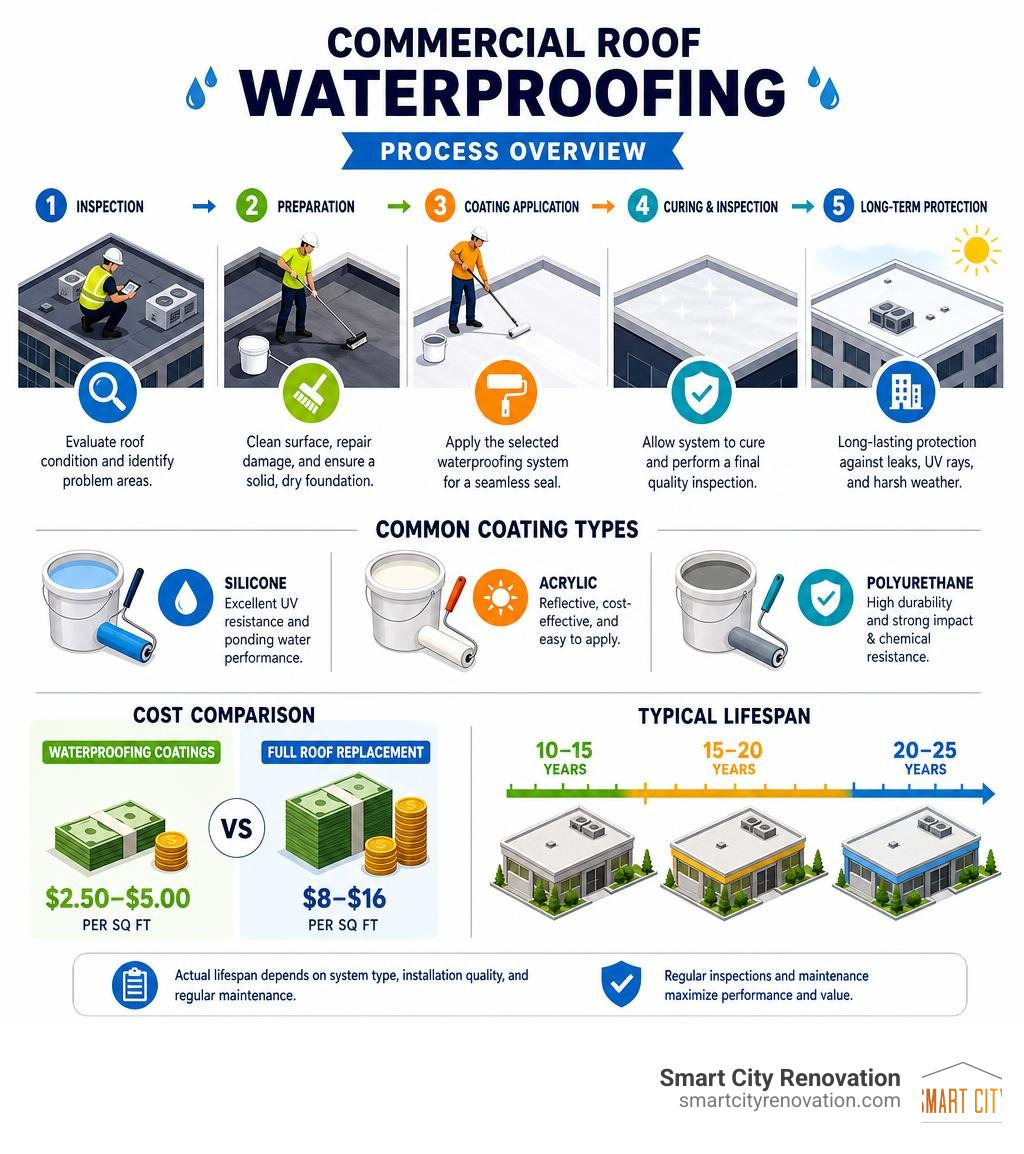
| Cost range | $2.50–$5.00/sq ft for coatings vs. $8–$16/sq ft for full replacement |
| How long it lasts | 10–25 years depending on system type and maintenance |
| Energy savings | Reflective coatings can cut cooling costs by 10–30% |
Water doesn’t knock before it enters your building. It seeps through cracked seams, failed flashings, and aging membranes — and by the time you see a ceiling stain, the damage is already done. For Chicago-area commercial buildings, where freeze-thaw cycles and heavy rain test every weak point, a failing roof isn’t just an inconvenience. It’s a liability.
The good news? Most commercial roofs don’t need to be torn off and replaced. In many cases, the right waterproofing system can add 10–20 more years of service life at a fraction of replacement cost.
I’m Norbert, lead contractor at Smart City Renovation, and with 25 years of Chicagoland construction experience — including hands-on commercial roof waterproofing projects across Des Plaines, Park Ridge, and Niles — I’ve seen how the right system stops expensive damage before it starts. Let’s walk through everything you need to know to make a smart decision for your building.
The Core Benefits of Commercial Roof Waterproofing
As building owners and facility managers, we are constantly balancing operational costs against long-term capital investments. When it comes to building envelope preservation, keeping water out is your single most important job. Putting off roof maintenance might save a few dollars today, but deferred maintenance quickly snowballs into massive repair bills, ruined inventory, tenant disputes, and structural compromise.
By investing in a professional commercial roof waterproofing system, you secure several critical advantages:
- Unyielding Structural Protection: Water infiltration slowly rots wood decking, rusts structural steel, and degrades concrete decks. Waterproofing creates a monolithic, seamless barrier that seals these vulnerable substrates from moisture.
- Massive Energy Savings: Traditional dark roofs absorb solar heat, sending rooftop temperatures soaring up to 150°F or more on hot summer days. Modern reflective “cool roof” coatings bounce up to 85% of solar radiation away from the building. This can reduce cooling energy consumption by 10% to 30%, depending on your building’s layout, insulation levels, and local climate.
- Immediate IRS Tax Advantages: Unlike a full roof replacement, which the IRS classifies as a capital improvement that must be depreciated over a painful 39-year schedule, roof coatings are typically classified as maintenance. This means you can often expense the entire cost of the project in the very first year of application.
- Utility Rebates and Local Incentives: Reflective coatings that meet Cool Roof Rating Council (CRRC) or ENERGY STAR requirements frequently qualify for local utility rebates. In many jurisdictions, these rebates range from $0.10 to $0.30 per square foot, providing an immediate boost to your project’s return on investment (ROI).
For comprehensive advice on managing roof degradation and understanding when a system requires professional intervention, check out our resource on The Ultimate Guide to Roof Repair. We always recommend aligning your waterproofing strategy with guidelines from the National Roofing Contractors Association to ensure your property meets the highest industry standards.
Comparing Waterproofing Systems and Coating Chemistries

Commercial roofs come in all shapes, sizes, and substrates. Consequently, there is no “one-size-fits-all” solution. The right choice depends on your existing roof type, the slope of the deck, local weather conditions, and how much foot traffic your roof receives.
To help you evaluate your options, let’s break down the primary coating chemistries used in roof restoration today:
| Feature | Silicone Coatings | Acrylic Coatings | Polyurethane Coatings |
|---|---|---|---|
| Average Installed Cost | $3.50 – $5.00 / sq. ft. | $2.50 – $3.50 / sq. ft. | $4.00 – $6.00 / sq. ft. |
| Ponding Water Resistance | Excellent (withstands indefinitely) | Poor (degrades under standing water) | Good to Very Good |
| UV Resistance | Outstanding (won’t chalk or degrade) | Very Good (highly reflective) | Moderate (requires UV-stable topcoat) |
| Tensile Strength | Moderate (~270 psi) | Low | High (up to 1,200+ psi) |
| Elongation & Flexibility | High (350%+) | Moderate | Exceptional (stretches up to 600%) |
| Best For | Flat roofs with drainage issues | Sloped roofs, budget-conscious projects | High-traffic roofs, hail-prone areas |
Selecting the Right Commercial Roof Waterproofing System
When waterproofing a commercial roof, we generally choose between single-ply synthetic membranes, hot-applied rubberized asphalt, and liquid-applied resin membranes.
For buildings with complex geometries, numerous HVAC penetrations, and tight spaces, liquid-applied systems are incredibly effective. A high-performance, moisture-curing system like the SikaRoof® Liquid Membrane forms a fully bonded, seamless, and permanently flexible barrier. It cures rapidly — becoming rain-resistant in as little as 10 minutes — and is highly elastic, meaning it moves dynamically with the building as temperatures shift.
If your building has a traditional single-ply membrane (like TPO, EPDM, or PVC) that is structurally sound but starting to show its age, applying a specialized coating system can restore its waterproofing integrity without the environmental and financial cost of a full tear-off.
Silicone vs. Acrylic vs. Polyurethane Chemistries
Understanding the chemical properties of these coatings will help you make an informed decision:
- Silicone Coatings: Silicone is the gold standard for flat commercial roofs because it is completely unaffected by ponding water. While other coatings soften and delaminate when submerged, silicone remains stable. Systems like the Silicone SP System create a high-solids, low-odor, monolithic shield that is highly reflective and can be warranted for up to 20 years.
- Acrylic Coatings: Acrylics are water-based, environmentally friendly, and easy to apply. They offer excellent UV resistance and cost-effectiveness. However, they are highly sensitive to freezing temperatures during application and will degrade quickly if subjected to ponding water. They are best suited for sloped roofs with positive drainage.
- Polyurethane Coatings: Polyurethanes are solvent-based and moisture-cured. They possess incredible tensile strength, impact resistance, and elongation properties (often stretching up to 600% of their original size). This makes them perfect for roofs that experience heavy foot traffic, hail, or mechanical wear. They are highly resilient but typically require a UV-resistant topcoat to prevent yellowing and chalking over time.
Restoration vs. Replacement: The Financial ROI
One of the most common questions we hear from building owners in places like Morton Grove and Schaumburg is: “Should I restore my roof with a waterproof coating, or do I need a complete roof replacement?”
The financial difference between these two paths is staggering. A full commercial roof replacement typically costs between $8.00 and $16.00 per square foot, depending on the insulation requirements, membrane selection, and tear-off difficulty. On the other hand, a professional liquid-applied waterproofing restoration typically costs $2.50 to $5.00 per square foot installed. This represents a direct 50% to 70% cost savings upfront.
To put this into perspective, let’s look at a 20,000-square-foot commercial building:
- Option A (Full Replacement): $180,000 – $320,000 (plus potential business disruption, landfill fees, and a 39-year tax depreciation schedule).
- Option B (Waterproofing Restoration): $50,000 – $100,000 (completed with zero building downtime, fully expensed in Year 1, and eligible for energy rebates).
To find out how these numbers apply to your specific building and to explore your options, read through our Roof Coatings & Restoration Guide.
However, you must respect the 25% Rule. If a professional moisture survey reveals that more than 25% of your roof’s underlying insulation is wet or damaged, a coating is no longer a viable candidate. In that scenario, the wet materials must be torn out, and a full replacement is required to preserve the building’s structural integrity.
When you work with the best certified roofers near me, we will perform a thorough core analysis and moisture scan to ensure your roof is a healthy candidate for restoration. This prevents you from wasting money coating a roof that is already failing from the inside out. For long-term peace of mind, we can also help you secure No Dollar Limit (NDL) manufacturer warranties that cover both labor and materials for up to 20 years.
If you run an industrial facility with sensitive machinery, minimizing operational disruption is critical. Learn more about how we handle these high-stakes environments in our guide on Industrial Roofers Near Me for Reliable Building Maintenance.
Climate Adaptation and Substrate Preparation
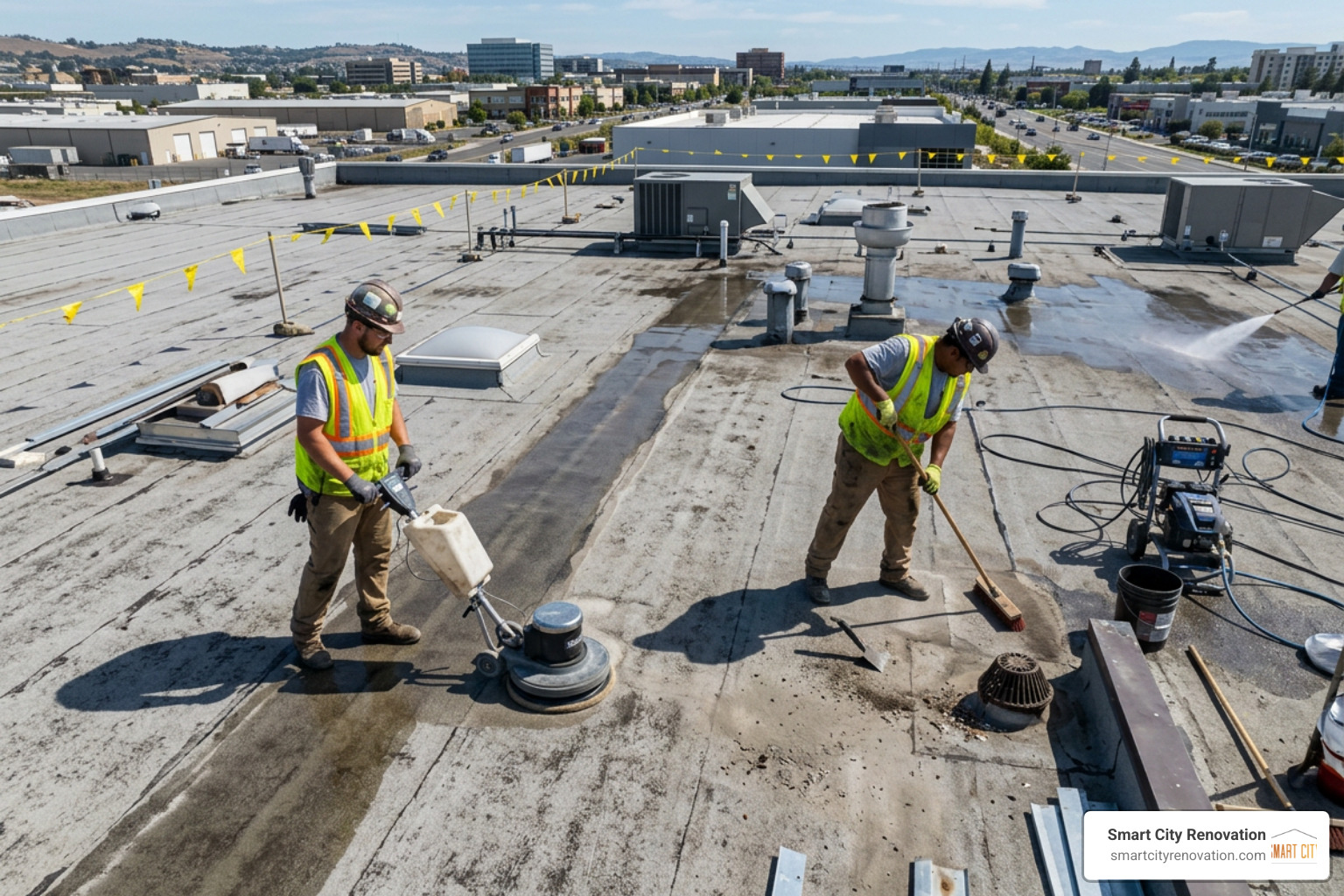
A waterproofing system is only as good as the surface it is bonded to. In fact, more than 90% of roof coating failures are caused by improper substrate preparation rather than material defects.
Substrate Preparation for Commercial Roof Waterproofing
To ensure a seamless, long-lasting bond, our team follows a rigorous, multi-step preparation protocol:
- Infrared Moisture Survey: We use advanced thermal imaging to detect any trapped moisture beneath the membrane. Any wet insulation is marked, cut out, and replaced with dry, matching materials.
- Adhesion Pull Testing: We perform field adhesion tests to verify that the selected coating chemistry will bond securely to your specific roof substrate. If the pull test results fall below 2.0 pounds per linear inch, we apply a specialized primer to enhance adhesion.
- High-Pressure Washing: We pressure wash the entire roof surface at 2,500 to 3,500 PSI using biodegradable cleaners to strip away dirt, grease, biological growth, and loose debris.
- Seam and Detail Reinforcement: We inspect every seam, flashing, and penetration. Any defective seams are detailed and reinforced using heavy-duty poly-mesh fabric or specialized high-build silicone mastics.
- Targeted Repairs: Before any liquid-applied membrane goes down, we repair active leaks and let the patches dry completely. For a deeper look at this process, check out The Ultimate Guide to Professional Roof Leak Repair.
Regional Climate Considerations
Here in the Chicagoland area — spanning from the windy lakefront of Evanston down to the commercial corridors of Des Plaines, Mount Prospect, and Arlington Heights — our roofs face brutal climatic extremes. We experience freezing winters with heavy snow loads, rapid spring freeze-thaw cycles, and blistering summer heat.
These extreme temperature swings cause commercial buildings to expand and contract dynamically — a phenomenon known as thermal shock. If your waterproofing material is too rigid, it will crack and split under this stress.
For our local climate, we highly recommend highly elastic, UV-stable systems such as SikaRoof® PUR-18. This polyurethane-hybrid system maintains its elasticity even in sub-zero temperatures, has an exceptionally high Solar Reflectance Index (SRI) of 112, and resists dirt pick-up, ensuring your building stays protected and energy-efficient year-round.
Maintenance and Inspection Protocols
Waterproofing your commercial roof is not a “set-it-and-forget-it” project. While modern liquid-applied membranes are incredibly durable, they still require proactive care to achieve their maximum lifespan.
We recommend implementing a semi-annual inspection schedule (ideally in the spring and autumn), as well as conducting targeted inspections immediately following major weather events, such as severe windstorms, heavy snowfall, or hail.
During a routine maintenance inspection, we focus on several key areas:
- Drainage Systems: We clear all leaves, twigs, and debris from roof drains, scuppers, and gutters. Standing water adds immense weight to your structure and accelerates the breakdown of non-silicone coatings.
- Seam Gaps and Flashings: We closely examine the transitions around HVAC units, pipes, parapet walls, and expansion joints. These are the most common failure points on any commercial roof.
- Physical Damage: We look for punctures, tears, or abrasions caused by windblown debris or careless HVAC technicians working on rooftop equipment.
- Documentation and Records: Keep a dedicated logbook of all inspections, repairs, and coating applications. This documentation is vital for keeping your manufacturer warranties active and valid.
Taking these small steps prevents minor issues from escalating into major disasters. To understand why working with experienced professionals is essential for these inspections, read our article on Why Professional Roofers Near Me are Worth the Investment.
Frequently Asked Questions about Commercial Waterproofing
How long does a commercial roof waterproofing system last?
A professionally installed commercial waterproofing system typically lasts between 10 and 25 years. The exact lifespan depends on the chemistry of the coating used, the thickness of the application (mil thickness), and how well the roof is maintained.
The best part? Once a silicone or polyurethane coating reaches the end of its warranty period, it doesn’t need to be torn off. As long as the membrane remains well-adhered, you can simply wash the roof and apply a thin “re-coat” to add another 10 to 15 years of watertight protection.
Can you apply a waterproof coating over an existing wet roof?
Absolutely not. Applying a waterproof coating over a wet roof is a recipe for disaster. Waterproof coatings are designed to keep water out, which means they are also highly effective at trapping water in.
If you coat over wet insulation or a damp membrane, the summer heat will turn that trapped moisture into water vapor. As the vapor expands, it will create massive blisters in your new coating, destroy the adhesive bond, rot your roof deck, and cause widespread system failure. A professional moisture survey must always be performed before any coating application.
Do reflective cool roof coatings qualify for tax deductions?
Yes! Because roof coatings are classified as a maintenance expense by the IRS rather than a capital improvement, you can typically deduct the full cost of the installation in the tax year the work is completed. Additionally, reflective coatings that meet Cool Roof Rating Council standards often qualify for local utility rebates, helping you save even more money right away.
Conclusion
Protecting your commercial property doesn’t have to mean drowning in massive tear-off and replacement bills. By choosing a high-performance commercial roof waterproofing system, you can extend your roof’s life by decades, slash your energy bills, and take advantage of immediate tax write-offs — all at a fraction of the cost of a new roof.
Key Takeaways to Remember:
- Waterproofing is a preventative shield: It stops structural rot, mold, and leaks before they disrupt your business operations.
- Substrate preparation is everything: Adhesion testing and moisture scans are non-negotiable steps for a successful application.
- Silicone is king for flat roofs: Its unique ability to withstand ponding water makes it ideal for low-slope commercial structures.
- Massive financial advantages: Save 50% to 70% compared to a full replacement, write off the expense in Year 1, and enjoy 10–30% lower cooling costs.
At Smart City Renovation, we bring 25 years of local contracting expertise to every commercial project across the Chicago suburbs. Whether your building is in Des Plaines, Niles, Morton Grove, or Schaumburg, our team is ready to help you protect your investment with a tailored, long-lasting waterproofing solution.
Don’t wait for the next heavy storm to test your roof’s limits. Contact us today at Smart City Renovation to schedule your professional roof inspection and moisture survey!